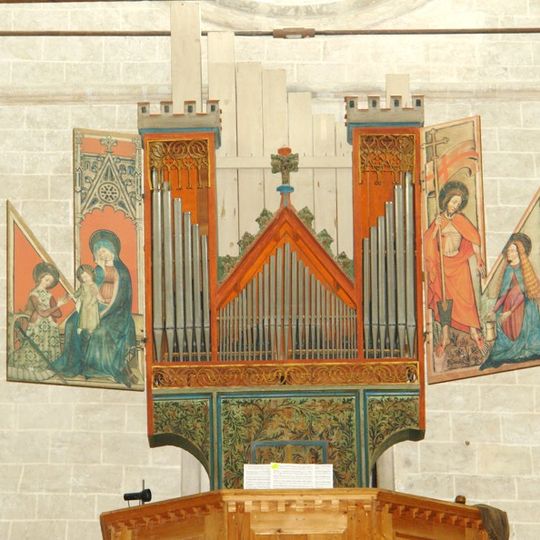
Pipe organ of Basilique Notre-Dame de Valère, Pipe organ in Basilique Notre-Dame de Valère, Sion, Switzerland.
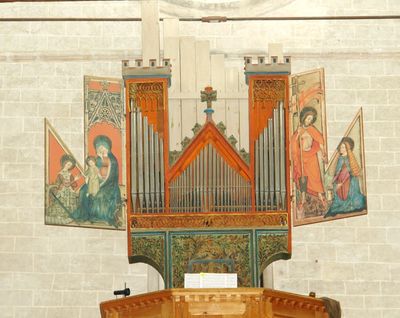
The organ of Basilique Notre-Dame de Valère hangs in a swallow's-nest gallery on the west wall of the nave. Its painted case, with Gothic tracery and folding doors painted by Peter Maggenberg, has a triangular centre flanked by two taller, narrower sections topped with crenellations resembling the town walls. The case dates from 1435; the gallery was built in 1628.
The organ dates to 1435, when the painter Peter Maggenberg was paid for decorating its case wings; carbon-14 testing supports this year. In 1686–1688 Christoph Aebi rebuilt it as a Baroque instrument, renewing the keyboards and converting the Gothic windchest into a slider chest. Johann Baptist Carlen added the Subbass 16′+8′ in 1812, and Hans-J. Füglister restored the instrument in 2004.
Since 1969 the organ has been heard each year at the international Valère organ festival. Its painted wings, attributed to Peter Maggenberg, show the Annunciation outside and, inside, the Madonna and Child and the Risen Christ with Mary Magdalene.
The organ hangs in a swallow's-nest gallery on the west wall, facing the nave, so it is seen from below and from the gallery level. Since 1969 the international Valère organ festival has brought regular recitals; the 2004 restoration left the tin tuning rings visible in the front pipes.
The painted wings that close the case are copies; the 15th-century originals by Peter Maggenberg, showing the Annunciation outside and the Madonna and Child inside, are kept in the Valère museum. The organ's nickname as the world's oldest playable organ traces back to the English organ builder Arthur George Hill, who examined the then-silent instrument in 1883 and also spread the incorrect date 1390.
The community of curious travelers
AroundUs brings together thousands of curated places, local tips, and hidden gems, enriched daily by 93,252 contributors worldwide.