Eidgenossenschaft, Sculpture in the Federal Palace, Bern, Switzerland
Die drei Eidgenossen is a limestone sculpture group by James Vibert, unveiled in 1914 in the dome hall of the Federal Palace in Bern. It shows Werner Stauffacher, Walter Fürst and Arnold von Melchtal standing on a stepped base, each extending a hand toward the Federal Charter held by Fürst. The block-like, strictly symmetrical figures weigh 24 tonnes and are carved from cream-coloured Botticino limestone.
In June 1898 the Federal Council launched a competition for a sculpture in the Federal Palace's dome hall, with the motif set by architect Hans Wilhelm Auer. The jury first chose Hermann Baldin in 1899, but rejected his models and cancelled his contract in 1902; at the palace opening that April a boys' choir sang instead. James Vibert received the commission in December 1910, worked about three years in his Carrara studio, and the group was unveiled on 15 May 1914, over twelve years late.
The three figures are Werner Stauffacher, Walter Fürst and Arnold von Melchtal, who according to the founding legend swore the Rütli oath. Each holds an outstretched hand toward the Bundesbrief held in Fürst's left hand, where the seals of the three Waldstätten are visible. The four bronze Landsknechte by Vibert on the stair posts in front were later read as representatives of the four national languages.
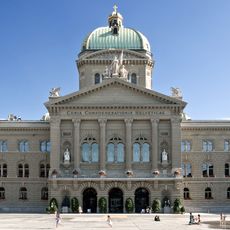
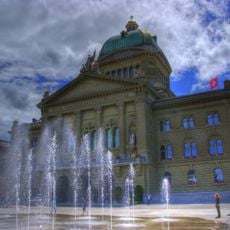
The sculpture sits near the main entrance of the Federal Palace and is easy to reach on foot. The plaza around it provides plenty of space to walk around and view the figures from different angles.
The three figures weigh 24 tonnes together. The cream-coloured Botticino limestone from near Brescia is one of the few foreign stones used in the Federal Palace, where Swiss building materials otherwise dominate. The stepped base is dark red limestone with white veins from near Yvorne.
The community of curious travelers
AroundUs brings together thousands of curated places, local tips, and hidden gems, enriched daily by 92,783 contributors worldwide.