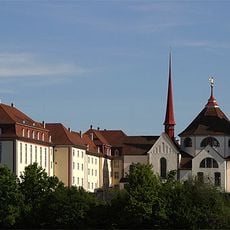
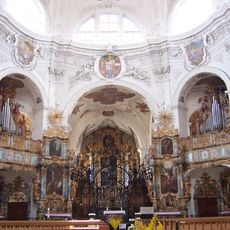
Loretokapelle, Chapel of Loreto at former Benedictine monastery, Muri, Switzerland
The Loretokapelle occupies three remaining bays of the north cloister wing of the former Benedictine abbey of Muri, entered from the south side of the monastery church. Its cross-ribbed vault is painted blue with the firmament, and the keystones are carved with the coats of arms of Abbot Plazidus Zurlauben and the monastery. A blue-painted altar structure with a low cartouche stands before a wooden grille; behind it, four angels flank a wooden Madonna by the Zug sculptor Johann Baptist Wickart.
The chapel was created in 1694–1697, when the Romanesque monastery church was rebuilt as a Baroque octagon and most of the cloister's north wing was demolished. In the three remaining bays Abbot Plazidus Zurlauben had a Loreto chapel installed, consecrated on 19 May 1698. In 1970 the Habsburg-Lorraine family signed a contract for a crypt beneath it, consecrated the same year.
The chapel reproduces the layout of the Holy House of Loreto, with a "kitchen" behind the altar grille and a wall niche standing for the fireplace. There stands a wooden Madonna flanked by four angels, carved by the Zug sculptor Johann Baptist Wickart. Since 1971 the hearts of Emperor Charles I and Empress Zita rest in silver caskets behind the altar.
The chapel is located on Marktstrasse in Muri, canton of Aargau, and is open to visitors during regular hours. It is worth checking ahead as the building remains actively used for religious services.
Behind the altar grille, a black marble stele in the wall niche shaped like the Holy House's chimney holds the heart urn of Emperor Charles I, who died in exile on Madeira in 1922. His wife Zita's heart was placed beside it in 1989, after her body lay in the chapel for about six weeks before burial in Vienna's Capuchin Crypt.
The community of curious travelers
AroundUs brings together thousands of curated places, local tips, and hidden gems, enriched daily by 94,050 contributors worldwide.