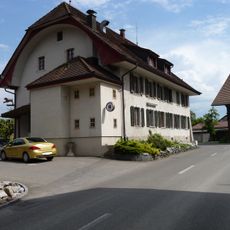
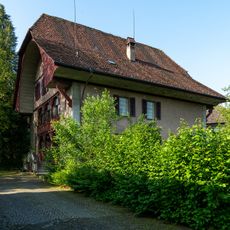
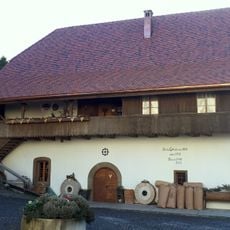
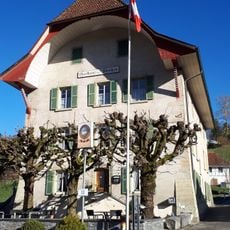
Rued Castle, Medieval château in Schlossrued, Switzerland.
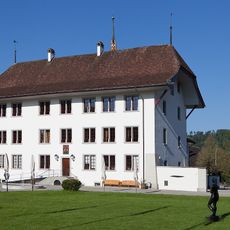
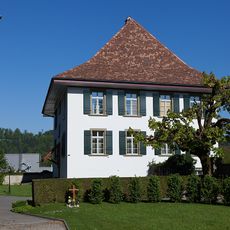
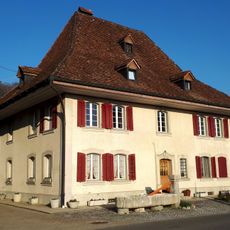
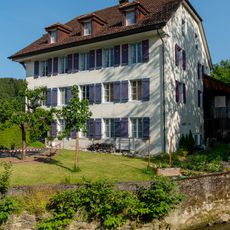
Rued Castle is a four-storey cubic building in early Neoclassical style on a hilltop spur jutting into the Ruedertal, northeast of Schlossrued village. Its high hipped roof and tower-like central risalit on the valley side recall a Bernese country house, though the building is heavier in proportion. An external staircase leads from the rear forecourt to the main entrance, and two concentric terraces, taken over from the earlier castle, surround the building.
The lords of Ruoda were first mentioned in 1155 as ministeriales of the Kyburgs, then of the Habsburgs from 1264; their line died out in 1369. Their original seat, Alt-Rued, stood about 400 metres away on the southern side of the valley and was destroyed by the Confederates in 1386 during the Sempach War. The lordship passed by inheritance to the Büttikon, then Rüssegg, Scharnachthal and Herport families before Glado May acquired it in 1520. A major fire destroyed the medieval castle in 1775; Carl Ahasver von Sinner built the present palace on the same spot between 1792 and 1796 for Carl Friedrich Rudolf May.
The name Rued comes from the lords of Ruoda, first mentioned in 1155 as ministeriales of the Kyburgs, later of the Habsburgs; the line died out in 1369. Their lordship passed by inheritance to the lords of Büttikon, in 1429 to the lords of Rüssegg, around 1450 to the Scharnachthal family and in 1491 to the Herport family of Willisau. In 1520 Glado May, whose family came from Lombardy and rose in Bern's patriciate, acquired castle and lordship.
The castle stands on a 50-metre rock spur north of the village, reached by road from Aarau or by train to Schöftland and bus to Schlossrued. A free staircase at the rear forecourt leads to the main entrance, and two concentric terraces, both inherited from the medieval predecessor, surround the building. The interior reopened in spring 2018 after renovation; the house now operates as a hotel and event venue, so visitors should check access before arriving.
Of the medieval castle, builder Carl Ahasver von Sinner kept only the southeast side; the rest of the main walls were demolished and the rubble used to fill the former moat. The two concentric terraces around the castle were taken over from the earlier building. From 1803 the site housed the Kulm district court archive for several years.
The community of curious travelers
AroundUs brings together thousands of curated places, local tips, and hidden gems, enriched daily by 93,672 contributors worldwide.