Haggenbrücke, Steel footbridge in St. Gallen, Switzerland
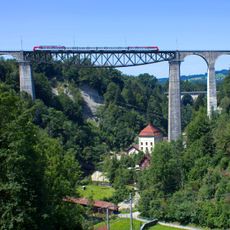
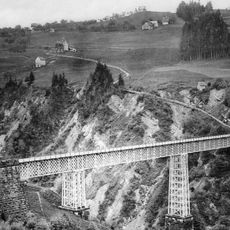
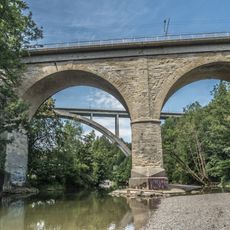
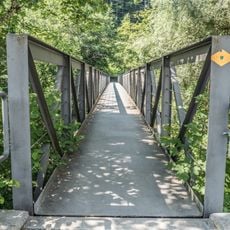
The Haggenbrücke is a 355.6-metre steel truss footbridge and cycle bridge over the Sitter, linking St. Gallen's Haggen district with Stein in Appenzell Ausserrhoden. It stands 98.6 metres high at its tallest point, is 3.8 metres wide and rises 3.9 percent from the Appenzell to the St. Gallen side, a difference of 14 metres. Six concrete piers are anchored directly to the rock, some reaching three metres below the water.
The steel truss bridge was built in 1936–37 by engineer Rudolf Dick and ironbuilder Ernst Scheer, after earlier attempts in 1885 and 1920 failed for lack of funding. It replaced the arduous mule track through the Sitter gorge, and its construction was financed by the canton, the city of St. Gallen, the municipality of Stein and many private donors. It was renovated in 2009–2010.
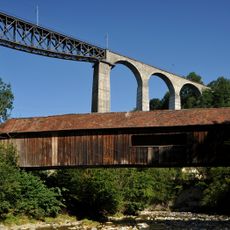
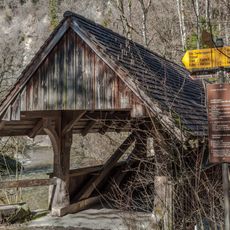
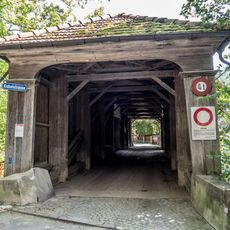
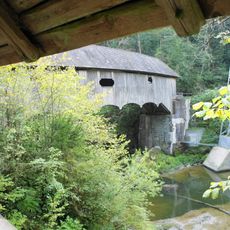
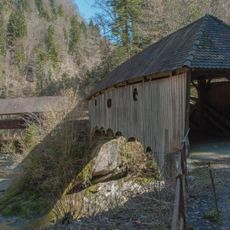
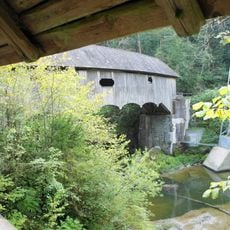
Locals call it Ganggelibrugg, from the dialect word ganggelen, "to sway", because the bridge shook under the 5,600 visitors at its opening on 31 October 1937. The name Eisensteg Zweibruggen refers to the two old covered wooden bridges over the Sitter and Wattbach in the gorge below. The bridge is a popular destination for walks into Stein AR.
The bridge is open to pedestrians and cyclists, not cars, though it has single-lane passing bays. It climbs 3.9% from the Appenzell side toward St. Gallen, with 14 m of height difference between the abutments. Safety nets were fitted in 2010; the walkway along the Wattbach to the old wooden bridges below is partly destroyed by erosion.
The bridge's nickname Ganggelibrugg comes from the East Swiss dialect word ganggelen, meaning to sway: at the opening on 31 October 1937, 5,600 visitors made the structure vibrate so strongly that an engineer's report led to reinforcements. The steel truss rests on six piers set in the rock, some reaching three metres below the Sitter's water level.
The community of curious travelers
AroundUs brings together thousands of curated places, local tips, and hidden gems, enriched daily by 92,683 contributors worldwide.