Hirzberg, Roman estate, with Roman mosaic floors in protective structures, Archaeological site in Zofingen, Switzerland.
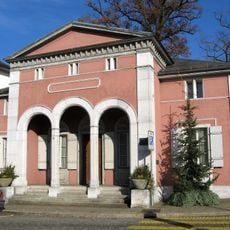
Hirzberg is the largest Roman villa rustica found in the canton of Aargau, with a main building about 120 metres long that had three main rooms and several side rooms, plus separate farm buildings. Two plastered half-timbered protective structures in the form of ancient prostylos temples, built in 1830/31, stand over the central residential wing and shelter the mosaic floors.
Built around the middle of the 1st century AD, the estate supplied food to the legionary camp at Vindonissa, today's Windisch. After Alamannic raids around 260 it was only intermittently occupied and was abandoned in the first quarter of the 4th century. In October 1826 the official Samuel Rudolf Sutermeister struck walls, mosaic fragments and a coin while digging on his land about 300 metres south of the old town.
The name "Römerbad" (Roman bath) comes from a mineral spring and clay pipes found in 1826, and it also named the inn Samuel Rudolf Sutermeister opened nearby, which still operates. The northern shelter holds a 9.9 by 6.6 metre polychrome mosaic with diamond and flower patterns; two smaller mosaics show flower motifs in diamonds and hexagons, and a black-and-white checkerboard.
The site is located in Zofingen and accessible to visitors interested in examining Roman remains. Wear comfortable shoes since you will walk over uneven ground to view the exposed structures and mosaics.
The northern protective structure shelters a 9.9 by 6.6 metre polychrome mosaic with diamond and flower patterns, plus two smaller floors: one of 7.3 by 5.6 metres with coloured flowers inside diamonds and hexagons, one of 3 by 3.9 metres in black-and-white checkerboard.
The community of curious travelers
AroundUs brings together thousands of curated places, local tips, and hidden gems, enriched daily by 92,864 contributors worldwide.