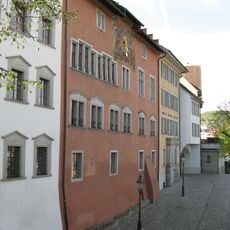
Bailiwick Castle, Medieval castle in Baden, Switzerland.
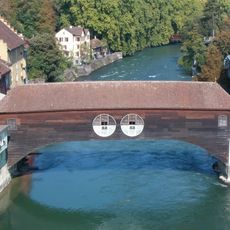
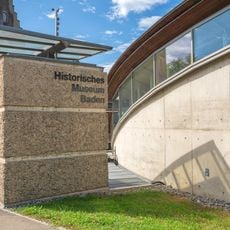
Bailiwick Castle is a three-story small castle on the right bank of the Limmat in Baden, opposite the old town. Its core is a keep built in the first half of the 12th century from quarry and pebble stones, around which additions in three stages created an irregular ground plan. The main wing forms a folded ellipse, with a passage to the covered wooden bridge on the south and a round stair tower called Schneggen on the east facade. A modern extension by architects Wilfrid and Katharina Steib, nicknamed Melonenschnitz, was added in 1992–93.
The Niderhus was built in the 12th century opposite Stein Castle and is first documented in 1265. It passed by inheritance to the Kyburgs in 1173 and to the Habsburgs in 1264. After Confederate troops took the Aargau in 1415 it was repaired and became the seat of the bailiff of the county of Baden. In 1486 the decision was taken to rebuild and enlarge it as the Landvogteischloss, completed in 1490.
The castle's name comes from the Landvogt, the bailiff sent each year by one of the Confederate cantons that had conquered the Aargau in 1415; he and his staff were the only Reformed residents of Baden after 1712. Since 1912 the building has housed the Historical Museum, whose exhibits trace the town's baths and industry from Roman times, alongside the city archive, kept underground and holding administrative records from 1300.
The castle sits in a hollow on the right bank of the Limmat, directly at the covered wooden bridge that leads across to the old town on the left bank. The museum entrance and the underground city archive are in the building itself, and the 1992/93 extension by Wilfrid and Katharina Steib adjoins the north-west facade. The site is at the narrowest point of the Baden valley, below the Lägerngrat slope.
The keep at the core of the castle was built in the first half of the 12th century from quarry and pebble stones, making it older than the 1265 first mention of the site as "Niderhus". The 1992/93 museum extension by Wilfrid and Katharina Steib, a curved modern addition on the north-west facade, is nicknamed "Melonenschnitz" (melon slice) by locals.
The community of curious travelers
AroundUs brings together thousands of curated places, local tips, and hidden gems, enriched daily by 92,723 contributors worldwide.