Reformed church, Reformed church in Herisau, Appenzell Ausserrhoden, Switzerland
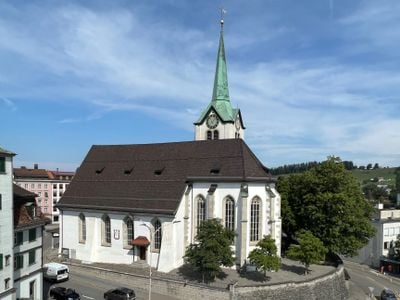
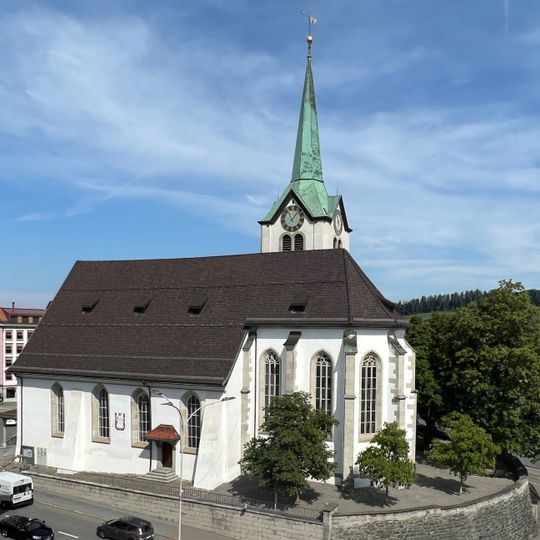
The Reformed Church is a place of worship in Herisau, Switzerland, with origins reaching back to medieval times. The structure combines late Gothic elements from the 1500s, an octagonal tower from the 1700s, Rococo decorations, Neo-Gothic updates from the early 1900s, wooden galleries, and a pipe organ installed in 1961 that remains in regular use.
A church on this site was first recorded in 907 and dedicated to the Holy Savior. Herisau was the last parish in the region to adopt the Protestant faith in 1529, and after a fire damaged the building in 1559, it was rebuilt in 1606.
The church is owned by the Einwohnergemeinde (municipal community) and stands under heritage protection. On the north side, a coat of arms stone shows the Appenzell bear with two keys, a privilege granted by Pope Julius II in 1512 after Appenzell mercenaries helped expel the French from Rome, though the Appenzellers never used it. The St. Anna Chapel, added around 1516–20 as a pilgrimage church, became a baptistery in 1959–60; its stained glass shows the baptism of Jesus.
The church is located in the center of Herisau and is accessible on foot from the main town area. Visitors can explore the interior to view the architectural details, the organ, and the small St. Anna chapel with its stained glass windows showing the baptism of Jesus.
The largest bell, the Herrgottsglocke, was cast in 1756 by Franz Anton Grieshaber of Waldshut and weighs about 9,120 kg, making it Switzerland's second-heaviest bell. Its ornament was designed by sculptor Joseph Anton Feuchtmayer. It first hung in Salem Monastery's minster; Herisau bought it in 1807 for 8,000 guilders.
The community of curious travelers
AroundUs brings together thousands of curated places, local tips, and hidden gems, enriched daily by 94,623 contributors worldwide.