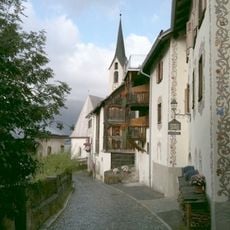
Reformierte Kirche Lavin, Reformed church in Lavin, Grisons, Switzerland
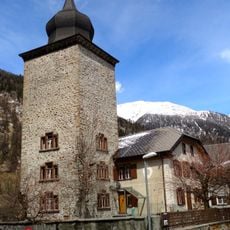
The Reformierte Kirche Lavin is a late Gothic church built around 1480, with a nave covered by a trapezoidal wooden ceiling installed in 1956 and a bell tower whose masonry slab roof dates from 1935. Its choir is painted with frescoes of about 1500, and the grey marble-painted pulpit from the late 18th century stands near a wooden communion table of 1667.
A first church, dedicated to Saint George, was built in 1325 after Lavin separated from the parish of Susch (or Ardez, according to the French source). The present late Gothic building dates from around 1480; its choir frescoes were painted around 1500, covered during the Reformation in 1529, and uncovered and conserved in 1955–1956 under Franz Xaver Sauter. Lavin adopted the Reformed faith in 1529 under Philipp Gallicius.
The church is locally called Baselgia San Görg, after Saint George, to whom the first church of 1325 was dedicated. The four bells hang on wooden beams in two tiers; the oldest, cast in 1563, bears the inscription "Verbum Domini manet in aeternum". A bell of 1469 kept in the choir is known as "sain da Gonda".
The church stands in the village of Lavin in the Lower Engadine, in the canton of Graubünden. The choir with its frescoes lies at the east end, the organ gallery and organ at the west end; the painted south window reveals carry the coats of arms of Bishops Ortlieb von Brandis and Heinrich V. von Höwen. The four bells hang on wooden beams in two levels of the tower, and the bell of 1469 kept in the choir is called "sain da Gonda" by locals.
Among the singing angels inside the church, four elements are depicted: a flame for fire, a dolphin for water, a breath bubble for air, and a globe for earth. This symbolic representation of nature is found in the historically valuable paintings within the sanctuary.
The community of curious travelers
AroundUs brings together thousands of curated places, local tips, and hidden gems, enriched daily by 93,896 contributors worldwide.