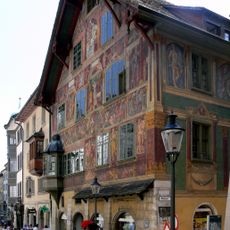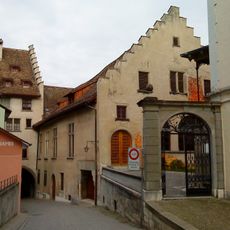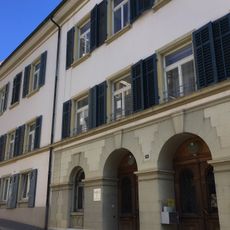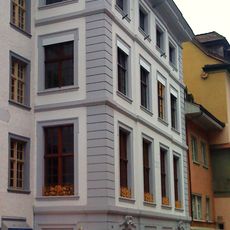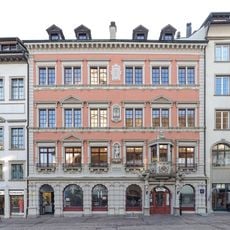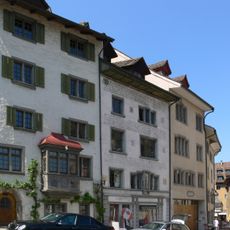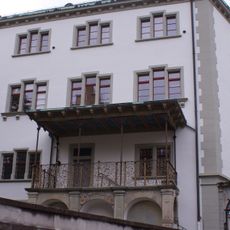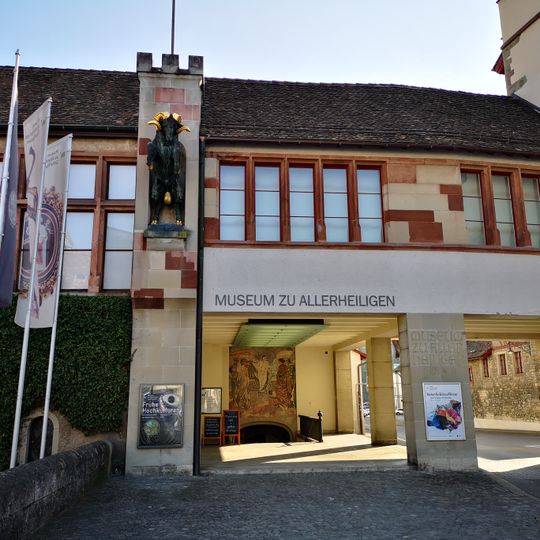
Museum zu Allerheiligen Schaffhausen, Art and natural history museum in Schaffhausen, Switzerland.
The Museum zu Allerheiligen Schaffhausen occupies a former Benedictine monastery and spans 6000 square meters of exhibition space in downtown Schaffhausen. The collections cover archaeology, regional history, natural sciences, and fine art from the Stone Age to contemporary work.
In 1919 the city council commissioned architects Schäfer and Martin Risch to convert the former Benedictine monastery into a museum, modelled on the Swiss National Museum in Zurich. After seven years of construction it opened in 1928 with 42 exhibition rooms; Karl Sulzberger was its first director until 1942. On 1 April 1944 American bombers mistakenly hit Schaffhausen, badly damaging the museum and destroying over 70 old-master paintings, including nine by Tobias Stimmer. Donations from cantons, firms and private individuals helped, and it reopened on 18 May 1946 after two years of rebuilding.
The name "zu Allerheiligen" refers to the medieval monastery's dedication to All Saints and signals the breadth of its collections. In the largest freely accessible cloister in Switzerland stands the Schiller Bell, which inspired Friedrich Schiller's "Lied von der Glocke". A herb garden and the Münster belong to the complex.
The museum is spread across the former Benedictine monastery, with the Ebnöther antiquities collection housed separately in a hall of the former Kammgarnspinnerei, reached by a covered passerelle over the Baumgartenstrasse. The complex includes the Münster, the herb garden and Switzerland's largest freely accessible cloister. A café and museum shop are on site.
The museum houses the Ebnöther collection with about 6000 archaeological objects, including a significant selection of pre-Columbian artifacts from the Americas. It also contains Switzerland's largest open monastery cloister.
The community of curious travelers
AroundUs brings together thousands of curated places, local tips, and hidden gems, enriched daily by 94,032 contributors worldwide.