Musée d'Art et d'Histoire, Art and history museum in Neuchâtel, Switzerland
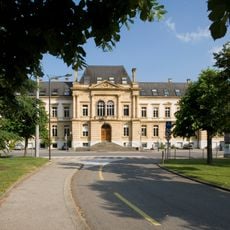
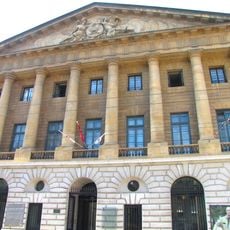
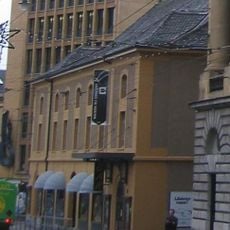
The Musée d'Art et d'Histoire occupies a palatial building erected between 1881 and 1887 to plans by Léo Châtelain, in the fine-arts district reclaimed from the lake. Its monumental entrance, symmetrical layout and décor of polychrome stones, mosaics and sculptures lead to a central vestibule and a monumental staircase decorated by Léo-Paul Robert. Nine first-floor rooms have overhead lighting.
The museum grew from collections documenting the region's development through art and historical objects. Around 400 items from the Suchard Chocolate Factory chronicle the evolution of chocolate production and commerce in Switzerland.
The three Jaquet-Droz automata — the Writer, the Draughtsman and the Musician — were made in Pierre Jaquet-Droz's watchmaking workshop in La Chaux-de-Fonds between 1768 and 1774. A clockwork mechanism powers them and a set of cams regulates their movements. They are among the museum's best-known pieces.
The building stands in the fine-arts district reclaimed from the lake, with two low wings added in 1952 and 1953 flanking the 1881–1887 main block. Rooms are arranged symmetrically around a central vestibule and the monumental staircase, with the nine first-floor painting rooms lit from above. Start at the stairwell before moving through the galleries.
The stairwell decoration by Neuchâtel painter Léo-Paul Robert is considered a total-artwork ensemble unlike any other in Switzerland. Its three monumental canvases depict the canton's regions: Neuchâtel as intellectual and moral life, Val-de-Ruz as rural life, and La Chaux-de-Fonds as industrial life. Robert worked with English decorative artist Clement Heaton, and the large stained-glass window was installed on the façade in 1908.
The community of curious travelers
AroundUs brings together thousands of curated places, local tips, and hidden gems, enriched daily by 92,718 contributors worldwide.