Parc de La Grange, Public park with neoclassical villa in Eaux-Vives, Switzerland.
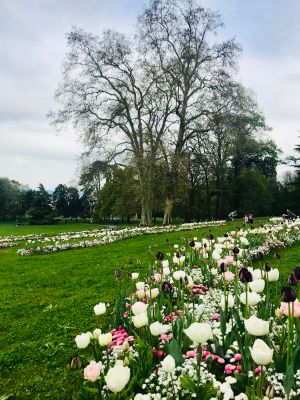
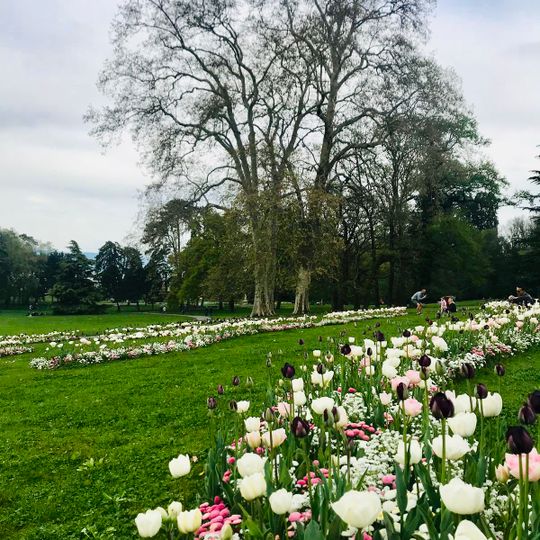
Parc de La Grange is a public park featuring a neoclassical villa in Geneva's Eaux-Vives neighborhood. The grounds include a rose garden with numerous varieties arranged on gentle slopes descending toward Lake Geneva, along with recreational facilities and ornamental plantings throughout the property.
Neolithic menhirs stand in the park, and a Roman villa of Titus Fronto, with ruins of a road, wall and gate from the 1st to 4th centuries, occupied the site. In the 18th century the Lullin family named the estate La Grange and had Jean-Louis Bovet design the villa, built in 1768–1773. In 1864 the first Geneva Convention was signed in the villa; William Favre bequeathed the estate to Geneva in 1918.
The park's name, La Grange, is French for "barn", given in the 18th century by the Lullin family to their country estate. The rose garden laid out in 1945–46 began the Geneva international competition for rose growers, where new varieties are shown each year. The villa can be visited only once a year, by registration, as places are limited.
The park provides playgrounds, a children's water basin, public restrooms, and free WiFi access points throughout the grounds. The pathways are well-maintained and easily accessible, making the space welcoming for families and individual visitors.
Two menhirs stand in the park, evidence of Neolithic occupation long before the Roman villa of Titus Fronto, whose ruins lie near them. Excavations also uncovered a Roman road and a fortification wall with gates, matching details in Konrad Witz's 1444 painting The Miraculous Draught of Fishes.
The community of curious travelers
AroundUs brings together thousands of curated places, local tips, and hidden gems, enriched daily by 92,721 contributors worldwide.