Gessler Castle, Medieval castle ruin in Küssnacht, Switzerland.
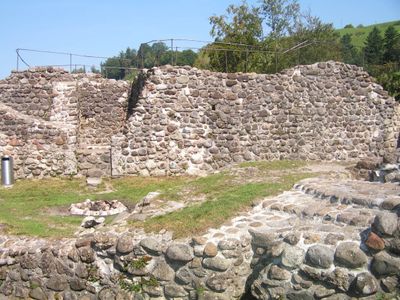
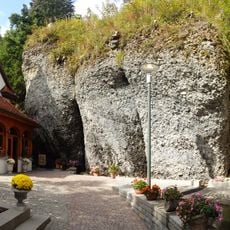
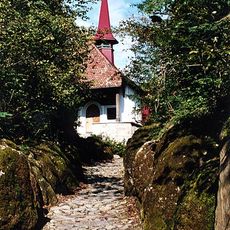
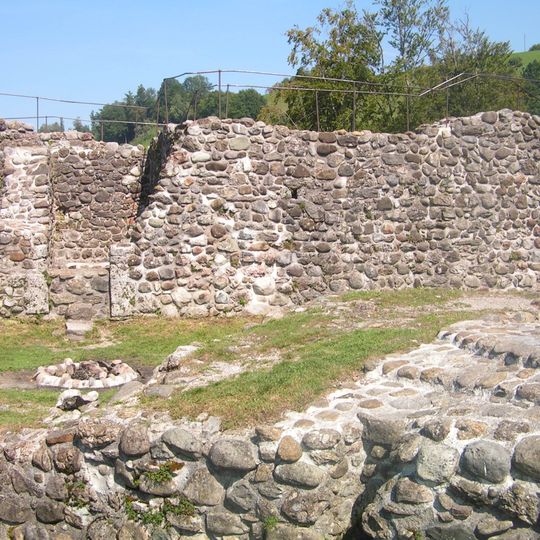
Gessler Castle is the ruin of a hilltop castle on a knoll east of Küssnacht, above the village stream that flows from the Seebodenalp into the lake. Its walls stand on the hill crest, and a path leads up from the Knochenstampfe, a streamside shed with a waterwheel where fertiliser was once produced.
The castle was first documented in 1263 as "in castro nostro Chüssenach". In 1291 Küssnacht passed by purchase from the monastery to Rudolf I of Habsburg, whose appointed bailiffs, the Lords of Küssnacht, held it; the line died out around 1352 with Knight Hartmann. Burn traces show partial destruction in the mid-14th century and a largely altered rebuild. From 1908 the Confederation bought the ruin, and Robert Durrer directed its excavation until 1916.
The castle's name comes from Hermann Gessler, the bailiff in Aegidius Tschudi's chronicle and Friedrich Schiller's play about William Tell. The real castle was held by the noble von Küssnacht family, whose line died out around 1352 with Knight Hartmann. In the 15th century the von Silenen family lived here, and Jost and Kaspar von Silenen were likely born at the castle.
The site is accessible on foot and lies within reach of local hiking paths around Kuessancht. Wear sturdy shoes because the approach is steep and crosses rocky ground.
The most important find from the excavations is a kettle hat (Topfhelm) from the second quarter of the 14th century, now held by the Swiss National Museum. It was not found beneath a staircase, and it is a helmet, not a model.
The community of curious travelers
AroundUs brings together thousands of curated places, local tips, and hidden gems, enriched daily by 94,187 contributors worldwide.