Eglisau Castle, Medieval castle in Eglisau, Switzerland.
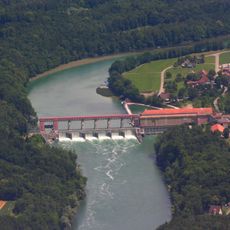
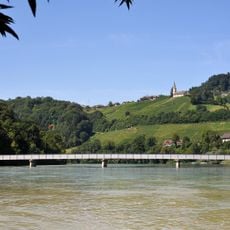
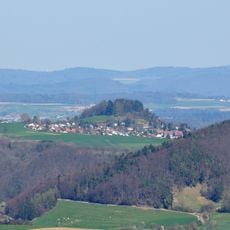
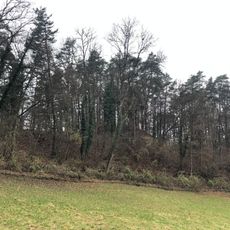
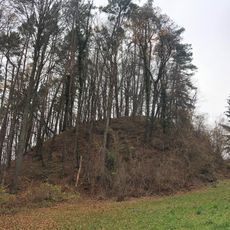
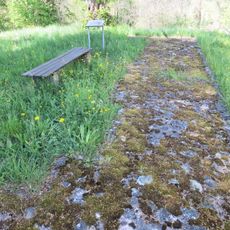
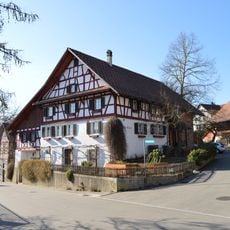
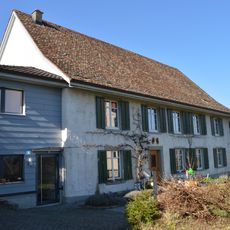
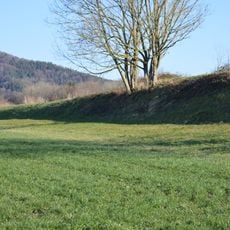
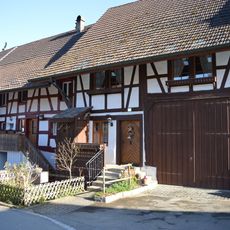
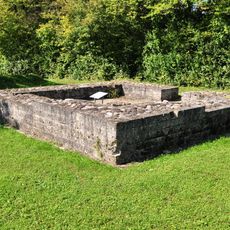
Eglisau Castle was a castle complex on the left bank of the Rhine opposite the town of Eglisau, built on a molasse rock spur, probably over the foundations of a Roman watchtower. Most of it was demolished in the 19th century: the New Castle in 1810/1811, the donjon and Ritterhaus in 1841/1842, the customs house in 1852. The castle barn with its metre-thick west wall and the stone arch bridge over the outer moat survive.
In the second half of the 11th century the Counts of Kyburg-Dillingen built a donjon on a molasse spur on the left bank of the Rhine. The barons of Tengen added the Ritterhaus in 1268, and in the late Middle Ages a Gothic Neues Schloss with a cruciform plan was built parallel to the river. Zurich bought the castle in 1463 and used it as the seat of its Landvögte from 1496 until 1789. The Neues Schloss was demolished in 1810/1811, the donjon and Ritterhaus in 1841/1842, and the customs house in 1852.
The castle reflects medieval local ownership and regional power dynamics visible through its elevated position above the river. Visitors can see in the remaining foundations and information panels today how such fortifications controlled important trade routes.
The site is accessible through designated walking paths with free access to the castle remains and foundations. Visitors should wear sturdy shoes since the ground is uneven and can be slippery in places.
The castle shares a long history with other Rhine fortifications in the region and shows typical patterns of medieval defense strategy along the river. Many of these fortifications were also demolished or remain as ruins today, shaping the entire landscape.
The community of curious travelers
AroundUs brings together thousands of curated places, local tips, and hidden gems, enriched daily by 92,744 contributors worldwide.