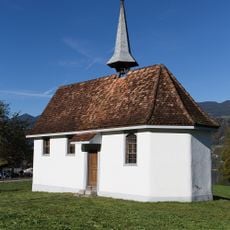
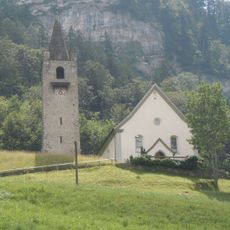
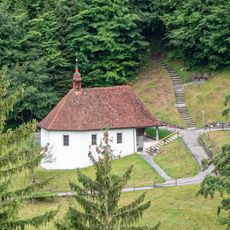
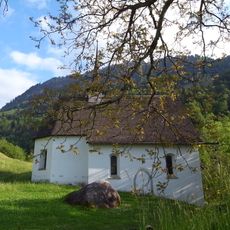
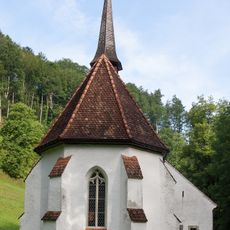
St. Karl Borromäus Chapel, Catholic chapel in Sachseln, Switzerland.
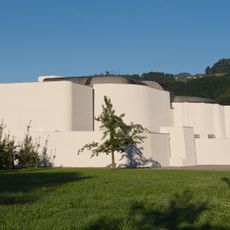
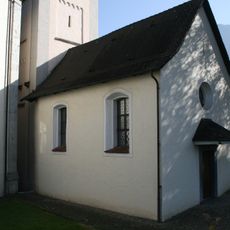
St. Karl Borromäus Chapel is the village chapel of Flüeli-Ranft, built from 1614 to 1618 in Renaissance style. It stands on the rock (Old High German fluoh) that gave the place and Bruder Klaus's family their name. The exterior is plain, with three small roof turrets topped by early Baroque bulbous copper-shingled domes; inside, the choir stalls and sacristy door carry inlaid woodwork, and the nave and choir have painted coffered ceilings.
Built between 1614 and 1618, the chapel emerged as an expression of religious devotion during the early modern period. Major restoration work in 1980 and 1981 ensured the structure could withstand the passage of time.
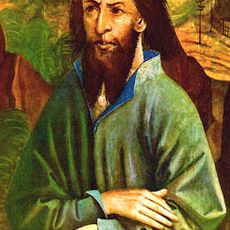
The chapel is dedicated to Saint Charles Borromeo, not Bruder Klaus: it was consecrated on 16 October 1618 in his honour by Konstanz auxiliary bishop Johann Jakob Mirgel. Borromeo, Archbishop of Milan, venerated Bruder Klaus and made a pilgrimage to his grave in 1570. The 19 oil paintings on the nave panelling show nine scenes from Bruder Klaus's life on the right and ten from Borromeo's on the left.
The chapel stands on the rock above the Sarneraatal, in the old part of Flüeli-Ranft within Sachseln. It is a protected cultural property of national significance, so visitors should treat the 17th-century furnishings with care. The interior is small and the choir is raised, with the pulpit now at choir-floor level.
The early Baroque high altar dates from the chapel's construction years and was donated by Count Alfonso Casati (1594–1621), the Spanish envoy residing in Lucerne. Its main painting, from the Italian school, shows Saint Charles Borromeo as a full-length portrait figure, with the Adoration of the Magi above.
The community of curious travelers
AroundUs brings together thousands of curated places, local tips, and hidden gems, enriched daily by 92,744 contributors worldwide.