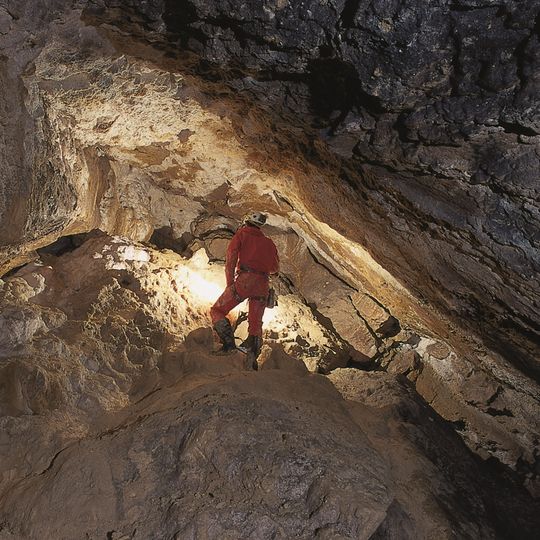
Grotte du Bichon, Archaeological cave in La Chaux-de-Fonds, Switzerland.
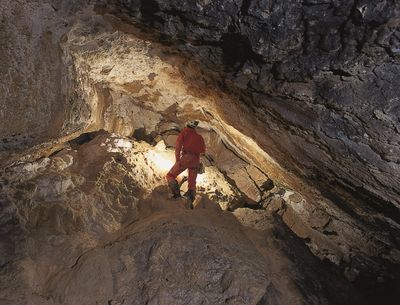
Grotte du Bichon is a karstic cave in the Swiss Jura at 846 m, overlooking the Doubs about 5 km north of La Chaux-de-Fonds. Its entrance, 2 m wide and 1 m high, leads to a hall 10 m long and 12 m wide, 2 to 4 m high; beyond, a lower chamber about 3 by 2 m opens, and a final space lies 5.5 m below the entrance.
Archaeologists explored the cave in 1956, discovering remains of a young hunter-gatherer from the Azilian period alongside flint tools and bones of a brown bear. This find provided key insights into human settlement patterns in the region during prehistoric times.
The cave is also called grotte du Pélard. Its finds are held in the natural history museums of La Chaux-de-Fonds and Geneva, where the intertwined skeletons of the young man and the brown bear are about 90% complete after the 1991–1995 excavation. A flint blade made from raw material from the Yonne shows how far objects or people travelled in the Azilian.
The cave opens on a steep slope facing the Côtes du Doubs, with an average gradient of about 40° at the entrance, so the approach is rough walking rather than a flat path. The entrance is only 2 m wide and 1 m high, and the floor drops 5.5 m from the entrance to the deepest space, so a torch and a helmet are useful. Excavation conditions were difficult enough that digging stopped in 1959.
A flint blade found in the cave comes from raw material in the Yonne, hundreds of kilometres away in France. It shows that either the objects or the people of the Bichon moved across long distances around 13,000 years ago.
The community of curious travelers
AroundUs brings together thousands of curated places, local tips, and hidden gems, enriched daily by 93,605 contributors worldwide.