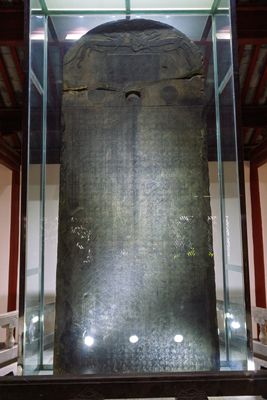
Cuan-Long-Yan Stele, Stone monument in Luliang County, China.
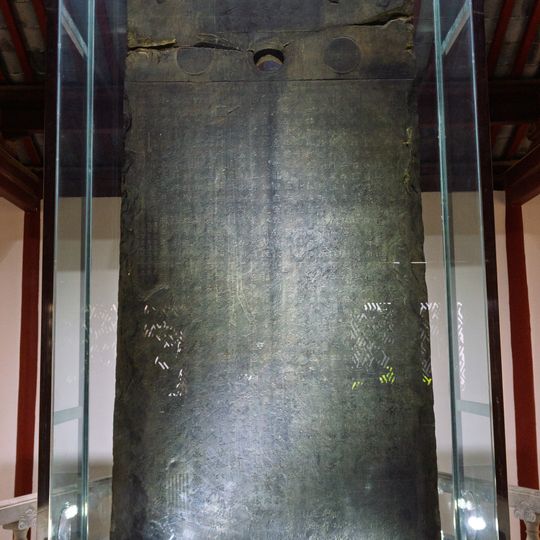
The Cuan-Long-Yan Stele is a dark grey sandstone slab standing upright in a glass case in Xueguanbao Village, Majie Town, Luliang County. The rectangular body, 3.38 m tall and 0.25 m thick, narrows toward the top; its face carries 24 columns of regular-script characters, about 904 in all, some 20 of them worn away. The rounded head bears a relief of dragon, tiger and bird figures, a 0.18 m perforation, sun and moon motifs, and a 24-character title.
The stone was created in the middle of the 5th century and served as a memorial to an important local official. The monument dates from a period when this region was under the rule of an early Chinese dynasty.
The Cuan (爨) family claimed descent from Zhuanxu and dominated this frontier region for generations; the text names Cuan Longyan's father as administrator of Jianning and Jin'ning commanderies. The stele was carved by kinsman Cuan Daoqing, and the reverse side lists 313 characters of official titles held by those who funded it. Local tradition holds the surrounding ground as the Cuan clan cemetery.
The stele stands in Xueguanbao Village, Majie Town, Luliang County, south of Qujing. The stone is kept upright in a glass display case, and reflections on the glass partly hide the middle and lower parts of the inscribed face, so look from several angles. The site is reached by road from Qujing via Luliang and Majie.
In 1823 the scholar-official Ruan Yuan, then serving in Yunnan, brought the stele to wide attention and praised it as Yunnan's oldest inscription, even carving a colophon into it. Earlier rubbings already existed, and the Cuan Baozi stele of 405 is older, so his claim was wrong, but his promotion made the stone known.
The community of curious travelers
AroundUs brings together thousands of curated places, local tips, and hidden gems, enriched daily by 93,850 contributors worldwide.