Wolong National Nature Reserve, Nature reserve in Wenchuan County, China
Wolong National Nature Reserve covers 200,000 hectares on the eastern side of the Qionglai Mountains in Wenchuan County, Sichuan. Its terrain drops from Mount Siguniang at 6,250 m to Muliangping at 1,150 m, a fall of 5.1 km over 48 km. Four main rivers, the Pitiao, Zheng, Xi and Zhong, cut V-shaped valleys, and vegetation runs from evergreen broadleaf forest up through subalpine conifer stands to alpine meadow and scree.
Wolong was established in 1963 at about 200 km2 and expanded in 1975 to roughly 2,000 km2 in the Qionglai Mountains. In 1980 the Chinese government began cooperation with the World Wide Fund for Nature and set up the China Conservation and Research Center for the Giant Panda. It became a UNESCO World Heritage Site in 2006 and joined Giant Panda National Park in 2020.
The reserve's name comes from the Chinese wòlóng, "crouching dragon". Its administrative seat is the Wolong Special Administrative Region, created in 1983 for a resident population of over 4,000 farmers and herders, mostly Tibetan, Qiang, Han and Hui. Villages such as Wolong town and Gengda township sit within the reserve, and farming income in 2019 came from morel mushrooms, konjac and medicinal plants like Paris polyphylla.
Before visiting, check current conditions and required permissions, as access varies depending on weather and wildlife protection activities. Planning ahead and asking locally ensures a smooth experience.
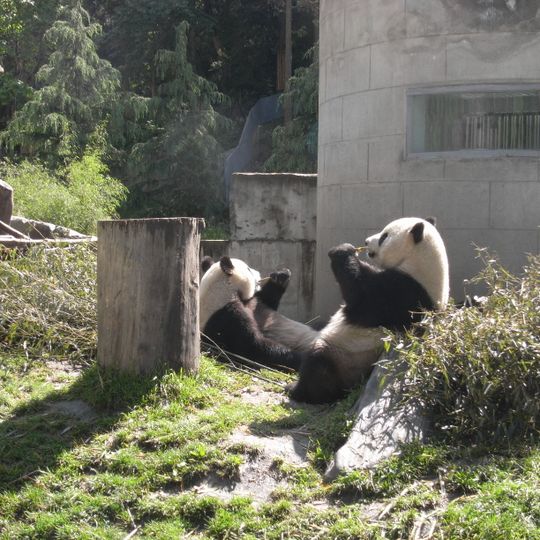
Bai Yun, born at Wolong in 1991, was the first female panda born there and the first loaned abroad, living at San Diego Zoo from 1996 to 2019 and giving birth to six cubs before returning to China with her son Xiao Liwu.
The community of curious travelers
AroundUs brings together thousands of curated places, local tips, and hidden gems, enriched daily by 92,781 contributors worldwide.