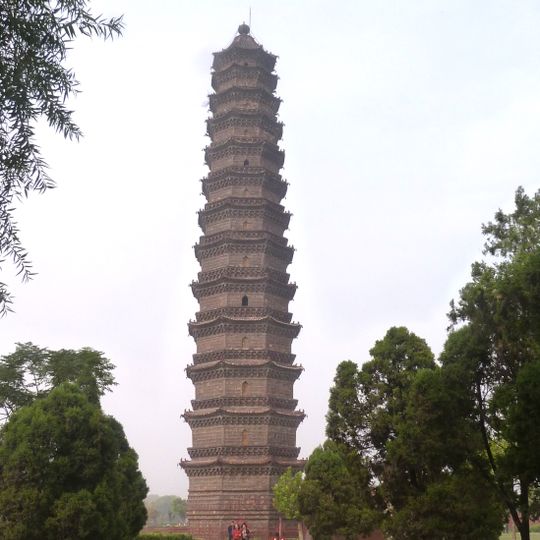
Iron Pagoda, Buddhist pagoda in Kaifeng, China
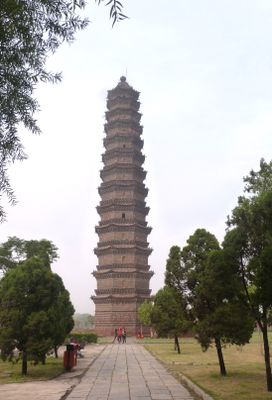
The Iron Pagoda is a 13-storey octagonal brick tower 56.88 m tall, its exterior clad in glazed bricks of red, brown, blue and green that read as iron-grey from a distance. Over fifty brick types carry some 1,600 carvings of Buddhas, monks, flying dancers, lions and dragons, and 104 bells hang beneath the eaves. The solid core holds a spiral stone stair, with openings admitting light and air.
The Northern Song architect Yu Hao built a wooden pagoda at Youguo Temple between 965 and 995; it burned after a lightning strike in 1044. Emperor Renzong ordered a brick replacement, completed in 1049 and named for its iron-grey look. The Yellow River flood of 1847 destroyed the temple, but the pagoda survived 38 earthquakes and six floods.
The name "Iron Pagoda" comes from the rust-red and brown glazed bricks that make the tower look cast in iron from a distance. Its walls carry more than fifty kinds of glazed brick and 1,600 carvings of seated and standing Buddhas, monks, singers, flying dancers, lions, dragons and flowers. Look under the eaves for 104 bells that ring in the wind.
The pagoda is a solid-core brick tower: its inner spiral stone staircase is not open to visitors, so there is no climb to upper floors. The exterior can be examined from the temple grounds, where the glazed bricks and carvings are best seen up close. The 104 bells under the eaves are heard when wind passes.
The structure has survived 38 earthquakes and six major floods over more than one thousand years while remaining stable despite being built on Yellow River silt. This resilience is noteworthy because it stands on one of the region's most unpredictable foundations.
The community of curious travelers
AroundUs brings together thousands of curated places, local tips, and hidden gems, enriched daily by 92,909 contributors worldwide.