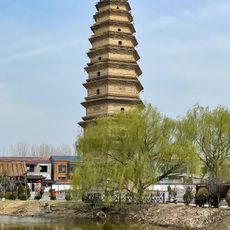
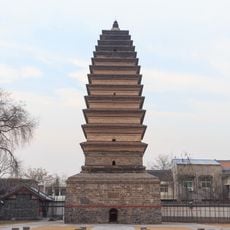
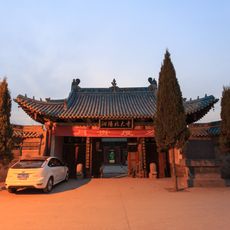
Jiayingguan, National Cultural Heritage Site in Wuzhi County, China.
Jiayingguan is a nationally protected cultural site on the northern bank of the Yellow River with traditional Chinese architectural structures and ceremonial buildings. The complex includes multiple interconnected buildings that form a coherent ensemble displaying typical features of ancient Chinese construction techniques.
Jiayingguan was built in 1723, the first year of the Yongzheng reign, when Emperor Yongzheng ordered a temple to the Dragon Kings of the Huai and Yellow rivers. It was listed in 2001 in the fifth batch of Major Historical and Cultural Sites Protected at the National Level. During the Yellow River flood-control campaigns, Fu Zuoyi and Soviet experts set up their command headquarters inside the temple.
The temple's full name, Huaihuang Zhuhé Longwang Miao (Dragon King Temple of the Huai and Yellow Rivers), reflects its role as a shrine where emperors and river officials sought divine protection from floods. The surviving theatre building in the South Courtyard was where villagers staged traditional Chinese opera during festivals.
The complex is divided into a northern and a southern courtyard; the northern one holds the main axis of gates, steles and halls, while the southern courtyard retains only a theatre building. Allow time to walk the full axis and the side halls. The site lies in Yangzhuang Village, Jiayingguan Township, Wuzhi County, reachable from Jiaozuo in Henan.
The temple was built in 1723 by order of the Yongzheng Emperor as the "Dragon King Temple of the Huai and Yellow Rivers", a name that ties it directly to river control rather than to any agricultural setting. During the Yellow River flood-control campaigns, General Fu Zuoyi and Soviet experts set up their command headquarters inside the complex.
The community of curious travelers
AroundUs brings together thousands of curated places, local tips, and hidden gems, enriched daily by 94,465 contributors worldwide.