Linglong Pagoda, Ancient pagoda in Yuanwu Town, China.
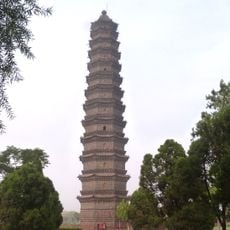
Linglong Pagoda, originally named Shanhu Temple Pagoda and also called Huita or Yanta, is a hexagonal thirteen-storey brick pagoda imitating timber-frame architecture, about 47.25 m tall. Only twelve storeys remain above ground; the lowest was buried by Yellow River silt. Its outline is slightly parabolic, each storey narrower than the one below, and the top is crowned with an iron finial.
Linglong Pagoda was first built in 1105, the fourth year of the Chongning era of the Northern Song, as an attached structure of Shanhu Temple. It was repaired in 1601, the 29th year of the Ming Wanli era, and restored several times afterward. During the Qing dynasty a fire destroyed Shanhu Temple while the pagoda survived alone. In 1938 Japanese troops shelled the tower but caused little damage.
The pagoda's name Linglong means "exquisite" in Chinese, though it was originally called Shanhu Temple Pagoda, and also Huita or Yanta. It stood as an annex of Shanhu Temple until a fire during the Qing dynasty destroyed the temple while the pagoda survived alone.
The pagoda stands outside the east gate of Yuanwu Town in Yuanyang County, Xinxiang, Henan. Its lowest storey lies buried in Yellow River silt, so the visible entrance is a converted arched door on the second storey, now facing south. The brick body leans toward the northeast, a tilt a visitor can judge from the base.
The pagoda leans toward the northeast, which is why it is also called a leaning tower. Its ground floor now lies buried in sediment from Yellow River floods, and the entrance was moved to the south side, rebuilt from a second-storey arched door.
The community of curious travelers
AroundUs brings together thousands of curated places, local tips, and hidden gems, enriched daily by 93,206 contributors worldwide.