Bishagang Park, Public park in Zhengzhou, China.
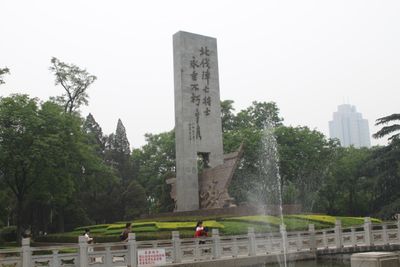
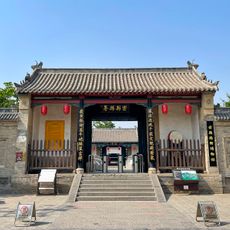
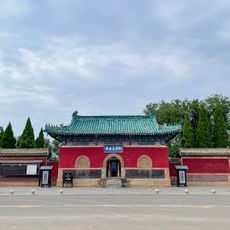
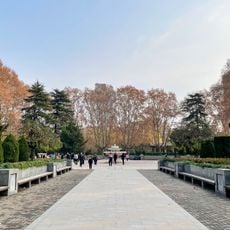
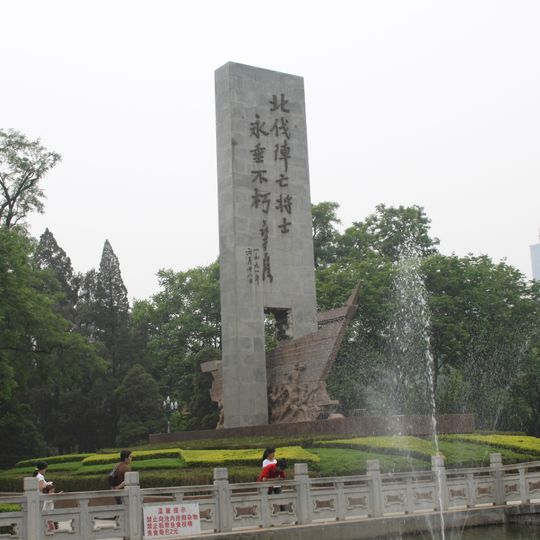
Bishagang Park covers about 400 mu at the southeast corner of Songshan and Jianshe roads in Zhengzhou's Zhongyuan District. Its north–south axis runs from the north gate to the Northern Expedition Monument, a nearly 18-metre obelisk with a relief of soldiers and gold characters by Nie Rongzhen. The grounds include the former Zhaozhong Shrine, three pavilions named Minzu, Minquan and Minsheng, and the old cemetery plots.
In 1928 Feng Yuxiang funded a 400-mu cemetery west of Zhengzhou for soldiers of the Second Group Army killed in the Northern Expedition. He named it Bishagang, from the phrase 'blue blood, red heart, blood soaking the yellow sand', and carved the name above the north gate. The grounds held a Zhaozhong shrine, three pavilions and the martyrs' cemetery. In 1956 the city turned it into a public park, opened on 1 May 1957.
The name Bishagang comes from Feng Yuxiang's phrase "blue blood and red heart, blood soaking the yellow sand", referring to the Northern Expedition dead. His calligraphy was carved in stone above the north gate. A white marble stele in the memorial pavilion repeats the four characters "Bixue Danxin" on its face, with his inscription for the fallen on the back.
The park is free to enter and offers restrooms, playgrounds, and fitness equipment scattered throughout the grounds. Multiple walking paths make it easy to navigate and explore different sections of the park at your own pace.
The name Bishagang comes from Feng Yuxiang's phrase "blue blood, red heart, blood soaking the yellow sand", referring to the fallen soldiers of the Northern Expedition. He had the three characters carved in stone and set above the north gate. The memorial park was built in 1928 on a sandy ridge then known as Baishagang, about 4 km west of the old city wall.
The community of curious travelers
AroundUs brings together thousands of curated places, local tips, and hidden gems, enriched daily by 94,396 contributors worldwide.