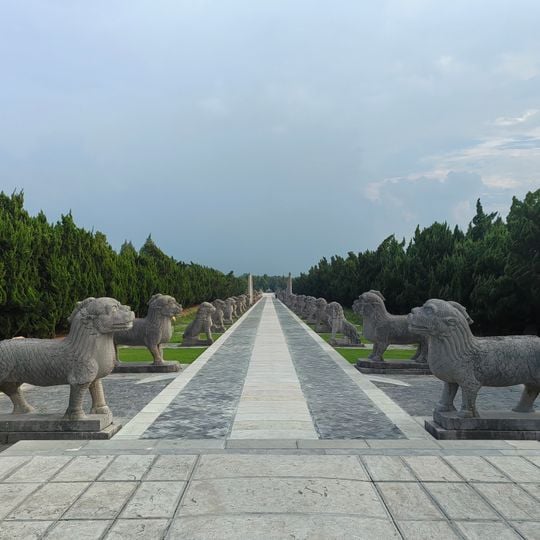
Huang Mausoleum of the Ming Dynasty, Ming Dynasty imperial burial site in Anhui, China
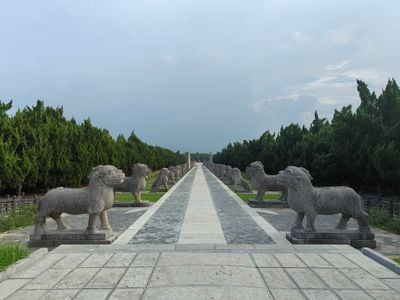
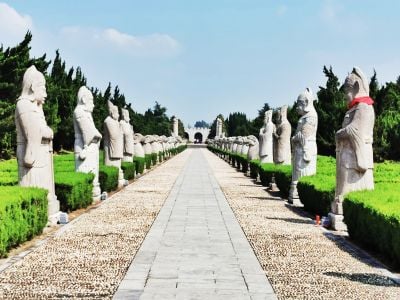
The Huang Mausoleum of the Ming Dynasty in Fengyang County, Anhui, is the burial complex Zhu Yuanzhang built for his father Zhu Shizhen and mother, Lady Chen. A long paved spirit path runs between rows of carved stone animals on rectangular bases, from pairs of qilin and lions to horses with grooms, tigers, sheep, civil officials, military officers and eunuchs, 28 pairs in all.
Zhu Yuanzhang built the tomb for his father Zhu Shizhen and mother Lady Chen, who died in the 1344 drought and epidemic; neighbour Liu Jizu donated the land. Construction ran from 1366 to 1379, and the stone figures on the spirit path were begun by February 1369. The site was repaired repeatedly into the Ming and Qing, damaged during the Cultural Revolution, and listed as a national key cultural relic in 1982.
Stone carvings along the Sacred Way depict officials and animals, serving as markers of the emperor's symbolic journey to the afterlife. These sculptures reflect the reverence that the Ming Dynasty held for its rulers.
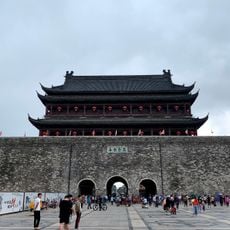
The stone figures line the spirit path between the brick-city Ming Tower and the inner-city Golden Gate, running north to south: 2 pairs of qilin, 8 of lions, 2 of columns, 2 groups of horses with grooms, 4 of tigers, 4 of sheep, 2 of civil officials, 2 of military officials and 2 of eunuchs, 28 pairs in all. The site lies 7 km south of Fengyang county seat, so plan the walk along the full row.
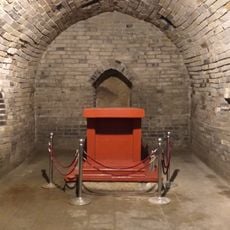
The tomb holds Zhu Yuanzhang's parents, Zhu Shizhen and Lady Chen, who died in the 1344 drought and epidemic; the land was donated by the neighbour Liu Jizu. The stele known as the Daming Huangling zhi bei is a key source on the emperor's family background.
The community of curious travelers
AroundUs brings together thousands of curated places, local tips, and hidden gems, enriched daily by 94,045 contributors worldwide.