Tomb of Tang He, Ancient burial site in Bengbu, China
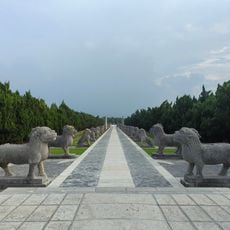
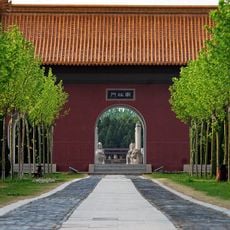
The Tomb of Tang He is a Ming dynasty burial site on the southern slope of Caoshan in Bengbu's Longzihu District. A 160-metre spirit road leads to a large stele and six pairs of stone figures—horses, sheep, lions and warriors. The brick-and-stone tomb chamber has a front room, rear room and one side chamber.
Tang He died in 1395, and this tomb was built for him on the southern slope of Caoshan. It was robbed repeatedly over the centuries. In 1973, while the Longzi Lake road was being built, archaeologists excavated the site and recovered more than 100 objects; the epitaph confirmed the tomb belonged to Tang He. Bengbu declared it a protected site in 1982 and Anhui Province followed in 1986.
The tomb is that of Tang He, a Ming founding general who died in 1395; the epitaph found in 1973 confirmed his identity. The 160-metre spirit road is lined with six pairs of stone figures, among them horses, rams, lions and warriors, and a large spirit-road stele. The site now forms the Tang He Tomb heritage park and serves as a patriotic education base for Bengbu.
The tomb lies at the southern foot of Caoshan in Longzihu District, on Bengbu's eastern outskirts; the site is reached via Longzihu Road, whose construction led to the 1973 excavation. The 160-metre spirit way with its stone figures and stele is walked on foot, and the burial chambers are entered from the front chamber through to the rear and side chambers.
The tomb was excavated in 1973 during construction of the Longzi Lake road, and the epitaph found inside identified the owner as Tang He. Among over 100 unearthed objects was a Yuan blue-and-white jar with beast-head handles and peony scrolls, now a national first-class relic and the Bengbu Museum's signature piece.
The community of curious travelers
AroundUs brings together thousands of curated places, local tips, and hidden gems, enriched daily by 93,900 contributors worldwide.