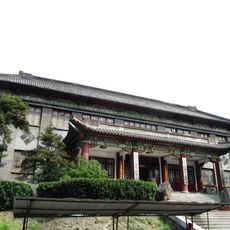
Mingjiao Temple, Buddhist temple in Luyang District, China.
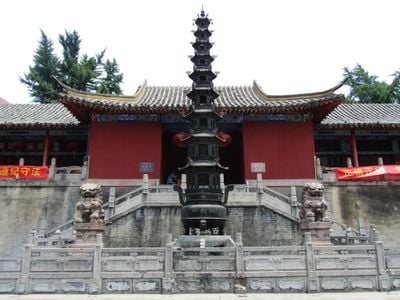
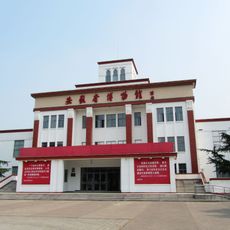
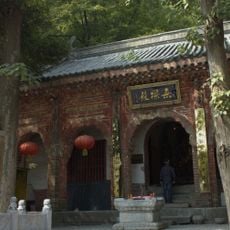
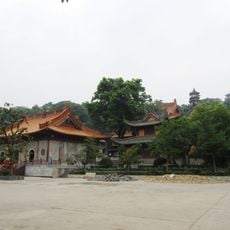
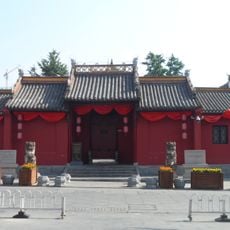
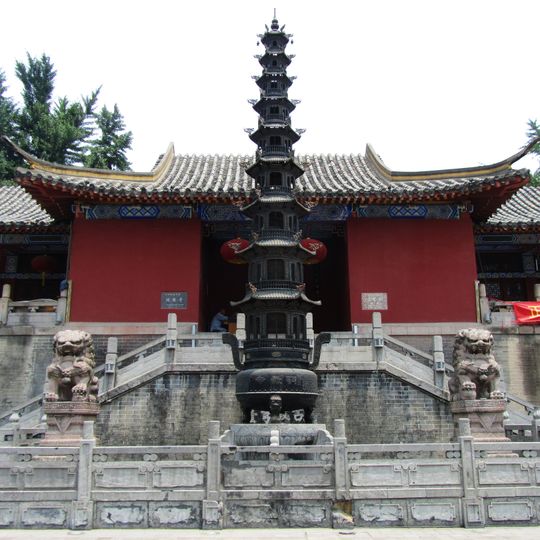
Mingjiao Temple is a Buddhist complex with multiple buildings arranged around courtyards that display traditional Chinese architectural elements. The main halls house statues of the Five Buddhas and eighteen sacred figures with intricate carved details.
Mingjiao Temple began in the early 6th century, during the Southern and Northern dynasties, as the Iron Buddha Temple on a platform where Cao Cao was said to have drilled troops. Destroyed after the fall of the Sui, it was rebuilt under Emperor Daizong of Tang after an iron Buddha was dug from the ruins; Pei Xiu, governor of Luzhou, reported the find. It took the name Mingjiao in the Ming dynasty, was devastated in 1853, rebuilt in 1870, and its Mahavira Hall restored in 1886 by the former Taiping general Yuan Hongmo.
The temple's name comes from the Mingjiao Temple of the Ming dynasty, but locals also call it "Cao Cao's review platform" after the warlord who drilled troops on the raised mound in the late Eastern Han. The iron Buddha dug from the ruins gave it the name Iron Buddha Temple. Since 1984 it has been open for worship as a National Key Buddhist Temple in the Han Chinese Area.
Mingjiao Temple stands on Huaihe Road in Luyang District, on the raised platform once called the Jiaonu Terrace, so visitors climb steps from street level to reach the gate. The compound is divided into Buddha halls, a scripture library and the west courtyard garden. The temple was reopened for worship in 1984 after its 1983 national designation.
According to local history, an iron Buddha statue was discovered in the ruins during an earlier period, which prompted an imperial ruler to fund a major reconstruction. This discovery is still part of the temple's story today.
The community of curious travelers
AroundUs brings together thousands of curated places, local tips, and hidden gems, enriched daily by 95,033 contributors worldwide.