Nanjing Yangtze River Bridge, Double-decker road and rail bridge in Pukou District, Nanjing, China
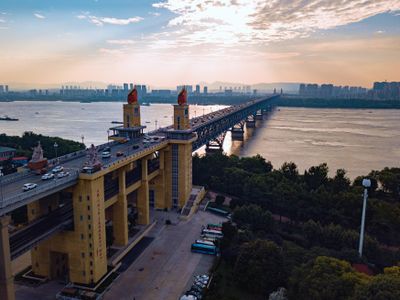
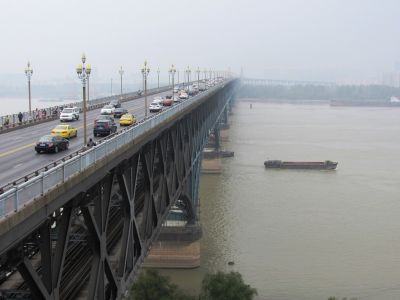
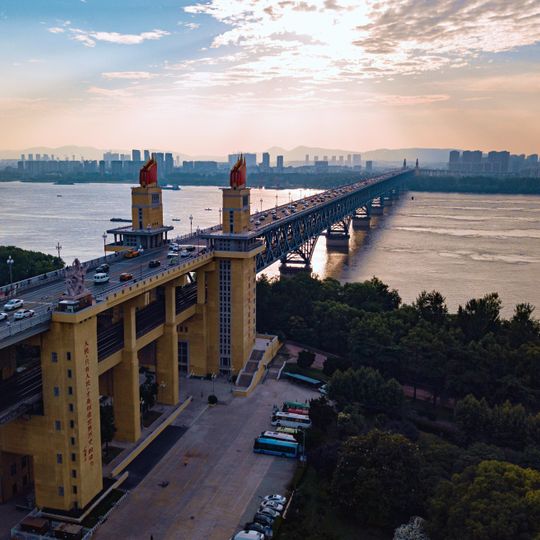
The Nanjing Yangtze River Bridge is a double-decked steel truss bridge across the Yangtze in Nanjing, connecting Pukou and Gulou districts. Its upper deck carries a 4,588-metre four-lane road, while the lower deck carries a 6,772-metre double-track railway. The main bridge has nine piers and ten spans, with a maximum span of 160 metres and a total length of 1,576 metres.
Construction began in January 1960 and concluded in September 1968, representing China's first large-scale bridge built entirely with domestic engineering expertise and materials during a period of industrial advancement.
The bridge became a national symbol of technological self-reliance and industrial progress, embodying the determination and collective effort of thousands of workers and engineers during the 1960s development era.
The bridge carries about 80,000 vehicles daily on its upper deck and 190 trains per day on its lower deck. It links the Beijing–Shanghai railway across the Yangtze, ending the river's role as a break in the line. The railway deck is not open to pedestrians.
The 202 cast-iron balustrade reliefs on the highway deck include 100 sunflower panels, 96 landscape panels and 6 national emblem panels; only 20 of the landscape designs repeat, showing sites such as the Beijing railway station, Daqing oilfield and the Qinghai–Tibet railway. Twelve artists and students from Nanjing Institute of Technology drew them between May and August 1968.
The community of curious travelers
AroundUs brings together thousands of curated places, local tips, and hidden gems, enriched daily by 92,787 contributors worldwide.