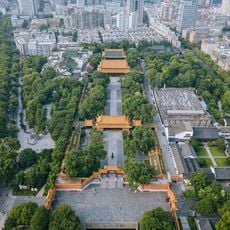
Drum Tower of Nanjing, Drum tower in Gulou District, Nanjing, China
The Drum Tower of Nanjing is a Ming-dynasty drum tower on Gulou Mountain, not a watchtower. Its lower storey is a brick-and-stone, beamless pedestal in the form of a city gate, 44.04 m long, 22.6 m wide and 8.9 m high, with three arched gateways on the north and south sides. The smaller upper hall, rebuilt in 1684, is a two-storey wooden structure with a double-eaved hip-and-gable roof.
Built in 1382 during the Ming Dynasty, the tower originally served as a timekeeping facility and ceremonial venue for welcoming dignitaries. Its construction reflects the administrative systems of that era, when such structures played central roles in urban organization.
The tower's name comes from the drums once kept on its upper floor: two large drums, 24 small drums, a cloud board, four ivory staffs, a clock and a bronze clepsydra. After the Ming fell, the wooden upper storey and the nearby bell tower were destroyed and the timekeeping equipment was lost. The rebuilt upper hall, named Changguan Lou, holds a stele erected by Viceroy Wang Xinming recording the Kangxi Emperor's southern tour; the wall bears the inscription "Bei Lou" (Stele Tower), though locals still call it the Drum Tower.
The tower is easily accessible in Nanjing's Gulou District and offers multiple levels to explore with views from above. Visitors should be prepared to climb stairs, especially to reach the upper floors and see the drum installation.
The upper hall, rebuilt in 1684 by Liangjiang governor Wang Xinming, houses a stone stele he erected. Its inscription records the Kangxi Emperor's southern tour to Jiangning and his instructions to officials of the Jiangnan region, which earned the building the name Stele Tower.
The community of curious travelers
AroundUs brings together thousands of curated places, local tips, and hidden gems, enriched daily by 93,816 contributors worldwide.