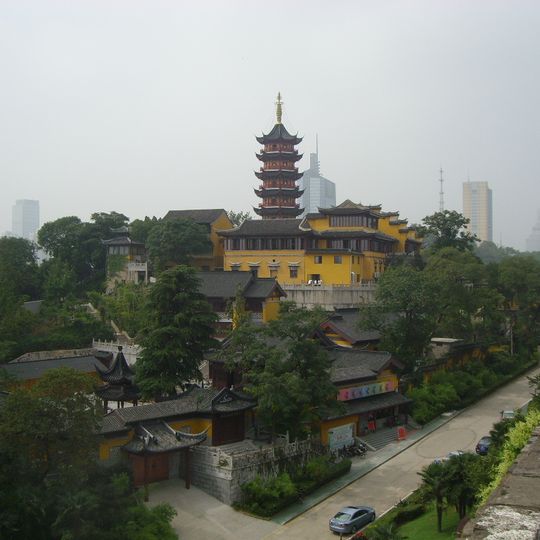
Jiming Temple, Buddhist temple near Xuanwu Lake, Nanjing, China
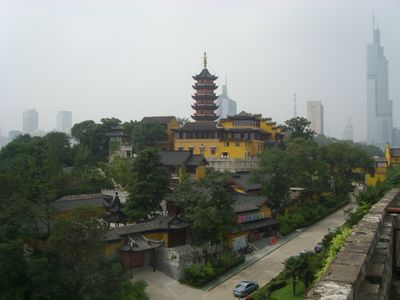
Jiming Temple stands on the eastern slope of Jilong Mountain by Xuanwu Lake, with yellow-walled halls and dark grey tiled roofs. At its centre rises the seven-storey, octagonal Medicine Buddha Pagoda, 44.8 m tall, fronted by lower halls on a raised grey stone terrace lined with small posts. A sign near the lower right entrance reads "JIMING TEMPLE".
A Buddhist site existed here by 527, when Emperor Wu of Liang built Tongtai Temple, where he several times took monastic vows; it was destroyed in the 549 Hou Jing rebellion. Yang Xingmi founded the Taicheng Thousand Buddha Court on the site in 922. In 1387 the Hongwu Emperor rebuilt the temple and gave it the name Jiming; it was later reduced by Taiping-era fire and rebuilt, and most buildings burned in 1973 before a 1981 restoration.
The temple's name means "rooster crowing." Since 1958 it has been a nunnery, and the Guanyin statue in its hall faces north, accompanied by a couplet asking why the bodhisattva sits backwards while people will not turn around. It is Nanjing's busiest temple, especially during the Lunar New Year.
Visitors can explore the complex daily and should wear comfortable shoes since touring the various buildings and climbing stairs through different structures is required. The best time to visit is early morning or on weekdays when fewer people are on site.
East of the temple stands the Rouge Well, also called the Well of Shame. In 589, when Sui troops took Taicheng, the Chen emperor Chen Shubao hid in it with consorts Zhang Lihua and Kong Guipin and was captured. The English article instead names a Southern Tang emperor, but the Chinese source gives the Chen dynasty account.
The community of curious travelers
AroundUs brings together thousands of curated places, local tips, and hidden gems, enriched daily by 93,838 contributors worldwide.