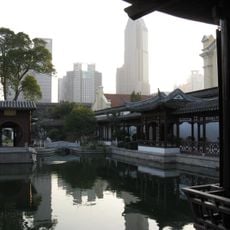
Nanjing Bell Tower, Bell pavilion in Xuanwu District, Nanjing, China
The Nanjing Bell Tower is a six-sided structure with a pyramidal roof and double eaves that rises approximately 14.5 meters high. A large bronze bell is suspended from an iron frame inside, occupying the central vertical space of the tower.
The bronze bell was cast in 1388, under the Ming Hongwu emperor, and first hung in Nanjing's Ming-dynasty bell tower, which held two bells. When that tower collapsed during the Kangxi reign of the Qing, both bells fell; the standing one was destroyed under Xianfeng. In 1889 Jiangning provincial administrator Xu Zhenyi built this pavilion to hang the surviving bell.
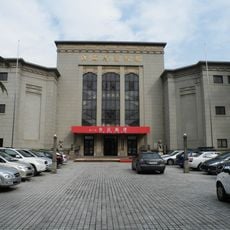
The name Dazhong Ting, "Pavilion of the Great Bell", refers to the 23-tonne Ming bell hung here. North of the pavilion stands the Sangu Dian, a hall said to honour three young women who died while the bell was being cast, described in one account as daughters of the Ming duke Kang Maocai and in another as the founder's daughters. Some annex buildings now house a restaurant, a use that has drawn controversy over the protection of the site.
The tower is located at the intersection of Zhongyang Road northeast of the Drum Tower and is accessible from the street. As a protected cultural site, visitors should check access conditions before visiting since entry may be limited.
The bell's neck carries a band of lotus-petal motifs, and its handle is cast with cloud and wave patterns. It hung in the Ming-dynasty Nanjing bell tower alongside a second bell; when that tower collapsed under the Kangxi emperor, both fell, one standing and one lying. The standing bell was destroyed in the Xianfeng era, and the lying one was hung here in 1889 by Jiangning financial commissioner Xu Zhenyi.
The community of curious travelers
AroundUs brings together thousands of curated places, local tips, and hidden gems, enriched daily by 94,139 contributors worldwide.