Grabstätte der Familie Wang am Xiangshan-Berg, Ancient burial site at Xiangshan Mountain, Jiangsu, China
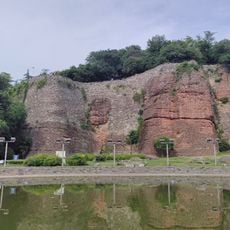
The Wang family cemetery at Xiangshan lies southwest of Mufu Hill in Nanjing's Gulou District and covers more than 50,000 square metres. Excavations since the 1960s uncovered eleven tombs of the Langye Wang clan, including Wang Xingzhi and his wife Song Hezhi in tomb 1 and Wang Danhu in tomb 3. Tomb 7, the largest and richest, is attributed to Wang Yi, brother of Wang Bin.
The cemetery belongs to Wang Bin, a high official of the Eastern Jin, and his relatives of the Langye Wang clan. Excavations since the 1960s uncovered eleven tombs; Wang Xingzhi was buried in 340 and his wife Song Hezhi in 348. Wang Bin's own tomb, recorded as lying between tombs 1 and 3, has never been found. The site became a national protected monument in 2006.
The epitaph of Wang Xingzhi and his wife Song Hezhi, carved in the Eastern Jin period, records his death and burial dates and his military rank; he was buried in 340, she in 348. Its calligraphy prompted Guo Moruo in 1965 to question the authenticity of Wang Xizhi's Lanting Xu, sparking a major debate.
The cemetery lies southwest of Mufu Hill in Nanjing's Gulou District, spread over more than 50,000 square metres, so the eleven excavated tombs are scattered rather than grouped. Excavations since the 1960s were carried out by the Nanjing cultural relics committee and the Nanjing Museum. Tomb 1 (Wang Xingzhi and Song Hezhi) and Tomb 3 (Wang Danhu) are the reference points for locating the others.
The 1965 discovery of Wang Xingzhi's epitaph in tomb 1 led Guo Moruo to question the authenticity of Wang Xizhi's "Lanting Xu" preface, setting off a major debate over the calligraphy's genuineness. The inscription records Wang Xingzhi's death and burial dates and his military rank under the Jin.
The community of curious travelers
AroundUs brings together thousands of curated places, local tips, and hidden gems, enriched daily by 93,282 contributors worldwide.