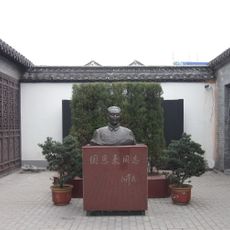
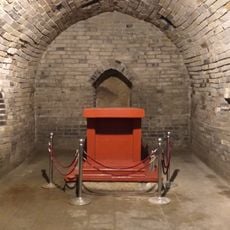
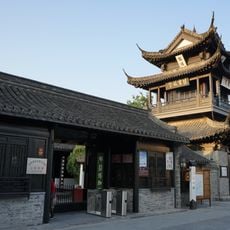
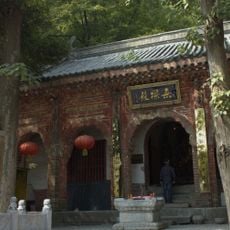
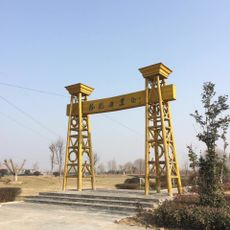
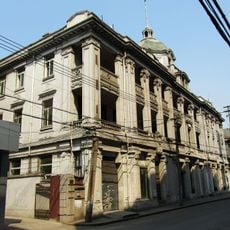
Ming Zuling, Imperial ancestral tomb complex in Xuyi County, China
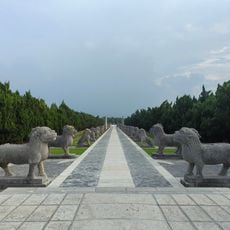
Ming Zuling is the first imperial mausoleum complex of the Ming dynasty, built between 1386 and 1413 by the Hongwu Emperor and his son Zhu Di. It lies north of the former town of Sizhou, near the Huai River's inlet into Hongze Lake in present-day Xuyi County. The site follows fengshui principles, with a sacred way lined with recovered stone statues and ornamental columns; most original gates and halls are now ruins.
The complex was built between 1386 and 1413 to honor Zhu Chuyi, grandfather of the Ming founder. It became an important memorial place for imperial ancestors of the Ming Dynasty.
The site's name, Zuling, means "Ancestors' Tomb." Zhu Yuanzhang's grandfather Zhu Chuyi was exhumed and reburied here, while the tombs of Zhu Sijiu and Zhu Bailiu are honorary cenotaphs. The three were posthumously elevated as the Xuan, Heng, and Yu emperors, and the complex let them receive veneration befitting that status.
The site is protected by embankments rising up to 15 meters high to shield structures from flooding caused by the nearby Huai River and Hongze Lake. Visitors should be aware of damp conditions that result from the site's proximity to these waterways.
The site sank beneath floodwaters in 1680 and remained hidden underwater for centuries. Drought conditions in the 1960s finally exposed ancient structures along the shoreline, allowing researchers to rediscover what was lost.
The community of curious travelers
AroundUs brings together thousands of curated places, local tips, and hidden gems, enriched daily by 94,460 contributors worldwide.