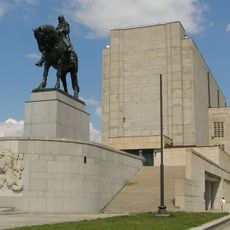
Vítkov, Mountain in Žižkov district, Czech Republic
Vítkov is an elongated hill, not a mountain, rising to 270.4 m at its northern end and 260.9 m in front of the National Monument. It separates Karlín from Žižkov, with partly wild woodland on its slopes that turns into a forest park and park to the east. A paved path runs along the ridge from the Ohrada junction to the National Monument, and a staircase climbs from Karlín.
On July 14, 1420, Hussite forces commanded by Jan Žižka defeated the army of Holy Roman Emperor Sigismund in the battle that took place here. This military victory became a defining moment in Bohemian history and shaped the region's understanding of resistance and national independence.
The functionalist National Monument, built 1928–1932, houses the permanent exhibition "Crossroads of Czech and Czechoslovak Statehood", covering 1918, 1938, 1948, 1968 and 1992. Legionary colonel Josef Jiří Švec was buried here; Klement Gottwald's mausoleum operated in the building from 1953 to 1962. The roof serves as a viewing terrace.
A paved path runs along the ridge from the Ohrada junction to the National Monument; further approaches exist from the south and west, and stairs lead up from Karlín on the north side. A sloping pedestrian tunnel from 1953 links Žižkov with Karlín, and a cycle path now follows the former Vítkov railway line and its old tunnel.
The baroque viewing pavilion west of the National Monument is a protected monument, and the roof of the monument itself is open as a lookout over Prague. Beneath the hill run four tunnel bores; the sloping pedestrian tunnel from 1953 links Žižkov with Karlín, and the old railway tunnel now carries a cycle path.
The community of curious travelers
AroundUs brings together thousands of curated places, local tips, and hidden gems, enriched daily by 94,631 contributors worldwide.