Zkamenělý slouha v Dolních Chabrech, Menhir in Dolní Chabry, Prague, Czech Republic
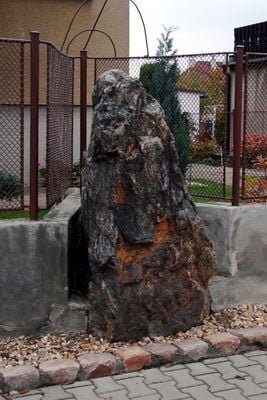
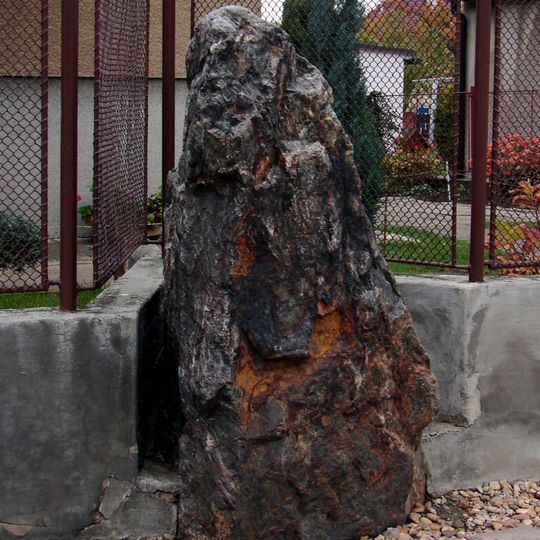
Zkamenělý slouha is a dark grey elongated boulder of buližník (a type of silica-rich rock) standing in Ládevská Street in Dolní Chabry, Prague 8. About 172 cm of its roughly 3 m length protrudes above ground, with a circumference at the base of about 2.75 m. It stands at the edge of the pavement in a niche of a villa's fence, and since 2006 a second similar stone, found buried nearby in 1980, stands beside it.
Archaeological survey dates the menhir's erection to 6,000–7,000 years ago, between 5000 and 4000 BC. It was probably quarried from the nearby Ládví hill. The stone has stood in its original position; the writer Eduard Štorch took the oldest photograph of it in 1914. In 1980 a second similar stone was found buried on the other side of the fence and was erected beside the first in 2006.
The name Zkamenělý slouha, meaning "Petrified Servant", is of unknown origin; it is thought to refer to the stone's shape, which resembles a leaning figure. Local tradition also attributes to the menhir the power to increase female fertility.
The menhir stands on the edge of the pavement in a niche of a villa's fence on Ládevská Street, near house no. 542, about one kilometre north of the Kobylisy tram depot. The second stone, raised in 2006, stands beside it. The stone is in a residential street with a pavement, so it can be seen on foot at any time.
In 1980 a second, similar stone was found buried just across the fence from the menhir; it was set upright beside the original in 2006. The writer Eduard Štorch took the oldest known photograph of the stone in 1914, when it still stood alone in open fields.
The community of curious travelers
AroundUs brings together thousands of curated places, local tips, and hidden gems, enriched daily by 94,633 contributors worldwide.