Nassau Castle, Medieval castle in Nassau, Germany
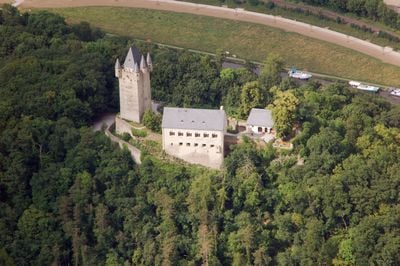
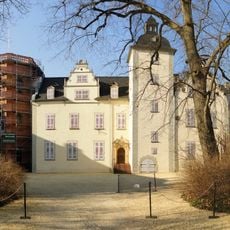
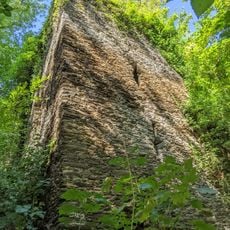
Nassau Castle stands on a rock outcropping about 120 m above the Lahn River. Its five-sided bergfried rises 33 m and is topped by a hipped roof with four small corner turrets. The adjoining palas, rebuilt in 1979–80 on the historic foundations, has light plastered walls with a row of arched openings above a row of square windows. The lower storey and cellar were originally built of layered dark slate, the upper storey of light tuff blocks.
Founded around 1100 by Dudo of Laurenburg, the castle passed in 1120 to his sons Rupert I and Arnold I, who renovated it in 1124. A dispute with the Bishopric of Worms over the site was settled in 1159, when the family became Counts of Nassau. Henry II built the late-Romanesque palas between 1220 and 1230, and the five-sided bergfried was added in the first half of the 14th century. The counts left by the end of the Middle Ages, and the ruins were further destroyed in the final phase of World War II.
The castle gave the House of Nassau its name: the counts called themselves "Counts of Nassau" after the fortress, first recorded with Henry I in 1160. Their descendants still rule the Netherlands and Luxembourg. In the bergfried's third floor the town registry office runs a wedding room, and the palas hall can be rented for events.
Access is available from below, though reaching the castle grounds requires some effort due to the slope and elevation. Comfortable shoes are recommended, and visitors should allow enough time to explore the interior areas.
Archaeological work in 1970 uncovered the original walls, which sparked extensive restoration efforts beginning in 1976. These discoveries revealed important details about how the fortress was originally built and laid out.
The community of curious travelers
AroundUs brings together thousands of curated places, local tips, and hidden gems, enriched daily by 93,819 contributors worldwide.