Rotes Rathaus, Town hall in Mitte, Germany
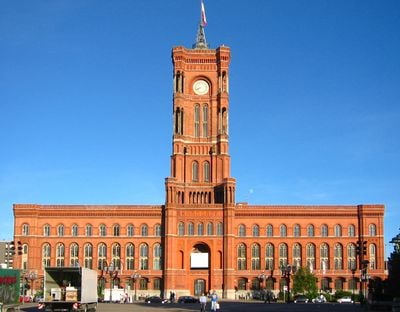
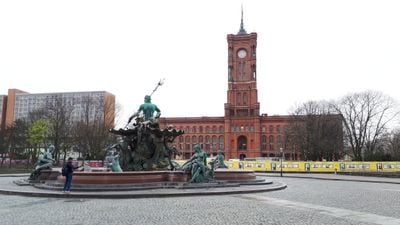
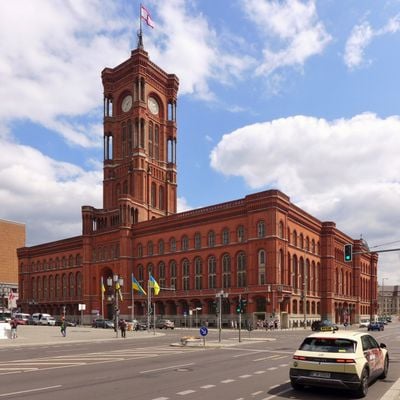
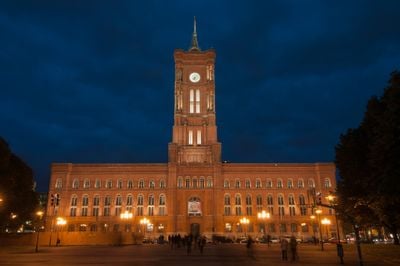
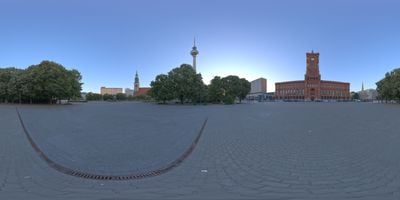
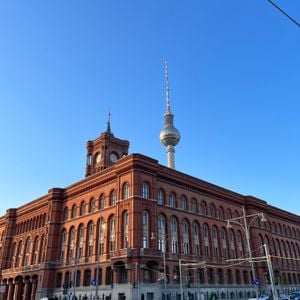
The Rotes Rathaus is Berlin's town hall, a square red-brick building on Rathausstraße near Alexanderplatz. Its four wings, each 99 m long, enclose three inner courtyards, and the facade rises 27 m to a surrounding cornice. The central tower reaches 74 m to its parapet and 94 m to the top, with a 4.75 m clock dial supplied by Johann Mannhardt.
Construction began in 1861 under architect Hermann Friedrich Waesemann and was completed in 1871. It then became the seat of Berlin's administration and has shaped the city center ever since.
The terracotta frieze on the first-floor balcony, made between 1876 and 1879 by Ludwig Brodwolf, Alexander Calandrelli, Otto Geyer and Rudolf Schweinitz, consists of 36 relief panels of 4 by 6 metres showing events in the history of Berlin and Brandenburg from the 12th century to the founding of the empire in 1871. The tower carries eight heraldic bears in coloured glazed clay, designed by Friedrich Wilhelm Wolff.
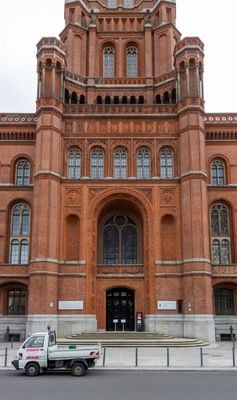
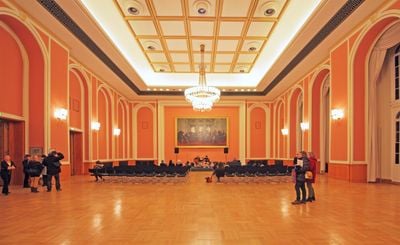
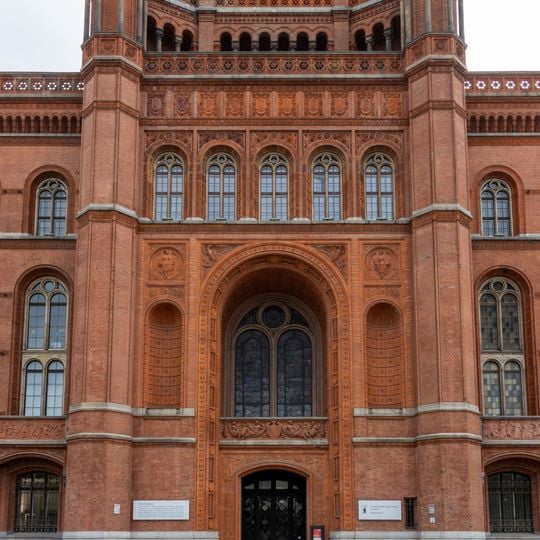
The main entrance is the large portal niche on Rathausstraße, facing the tower; the building occupies a full 99 × 99 m block, so the other fronts are on Jüdenstraße, Spandauer Straße and Gustav-Böß-Straße. The tower platform is reached by 375 steps but is closed to visitors, and peregrine falcons nest there. Three inner courtyards lie inside the block, one covered with a glass roof since the 2000s and used for large receptions.
The facade features relief sculptures depicting scenes of daily Berlin life, from craftwork to court proceedings. These sculptural representations offer a rare visual window into the social differences and activities of the city in the 19th century.
The community of curious travelers
AroundUs brings together thousands of curated places, local tips, and hidden gems, enriched daily by 93,471 contributors worldwide.