Neptunbrunnen, Baroque revival fountain in Mitte, Berlin, Germany.
The Neptunbrunnen is a neo-Baroque fountain in Berlin-Mitte, built by Reinhold Begas and inaugurated in 1891. Its quatrefoil basin of polished red granite measures 18 metres east-west and 16.70 metres north-south; the central group reaches 8.50 metres to Neptune's head and 10 metres to the tip of his trident. Neptune sits on a shell carried by four tritons above a rock with turtles, a seal, a crocodile and a snake, while four female river allegories sit on the rim.
The fountain was created by sculptor Reinhold Begas in 1891 and originally stood at Schlossplatz. It was relocated to its current position between Marienkirche and Rotes Rathaus in 1969.
The four women on the rim personify the Rhine, Vistula, Oder and Elbe, the main rivers of Prussia when the fountain was built. The Rhine carries a fishnet and grapes, the Vistula wooden blocks, the Oder a goat and animal skins, the Elbe ears of corn and fruit. Berliners joked that here sat four Berlin women who finally held their tongues.
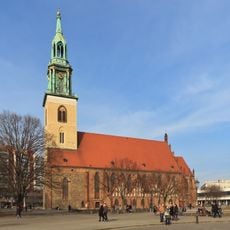
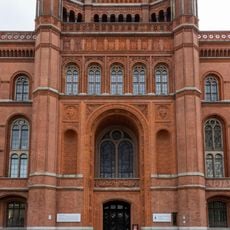
The fountain stands in the park by the Fernsehturm, between the Rotes Rathaus and the Marienkirche, not at Alexanderplatz. It is reached on foot from Alexanderplatz station or from the nearby S-Bahn station Hackescher Markt. The basin sits on a low circular granite step in a paved open area.
Berliners nicknamed the fountain "For(c)kenbecken" after mayor Max von Forckenbeck, in office when it was inaugurated, because Neptune's trident resembles a pitchfork. A rhyme said the four river women were the first Berlin women to finally hold their tongues. The site was once the Omphalos from which the Prussian mile was measured.
The community of curious travelers
AroundUs brings together thousands of curated places, local tips, and hidden gems, enriched daily by 92,837 contributors worldwide.