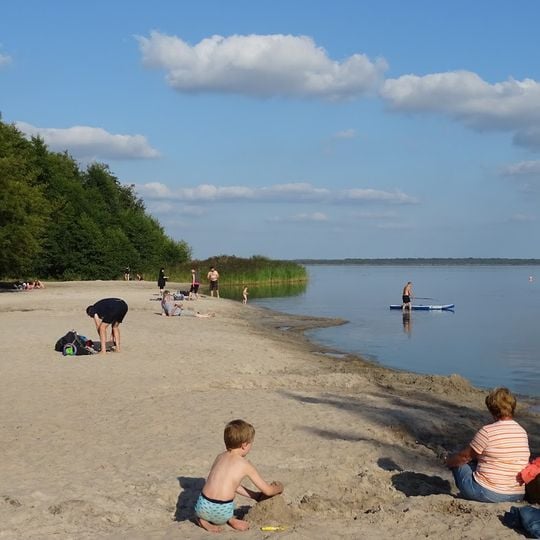
Steinhuder Meer, Lake in Wunstorf, Germany
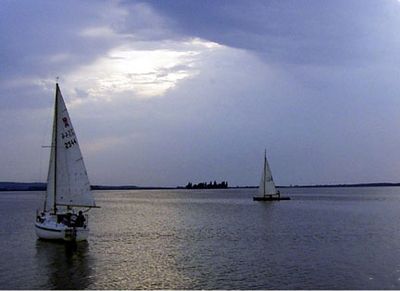
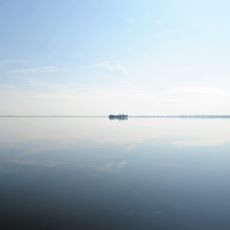
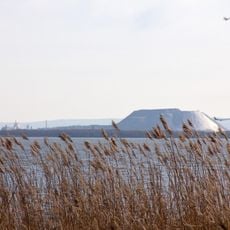
Steinhuder Meer is a lake of 29.1 square kilometres in Lower Saxony, about 30 kilometres northwest of Hanover, measuring 8 kilometres long and 4.5 kilometres wide. Its water is on average 1.35 metres deep and reaches at most 2.9 metres, with mud on the bed that waves stir up and keep the water turbid. In the middle lies the small artificial island of Wilhelmstein, whose square fortress with a pointed roof and small cupola rises above the water.
The basin formed around 14,000 years ago at the end of the Weichselian glaciation, when ice lenses heaved and thawed the ground, creating a shallow lake about three times its present size. The artificial island Wilhelmstein was built in 1761–1765 and fortified in 1765–1767 by Count William of Schaumburg-Lippe; from 1777 to 1867 it served as the principality's state prison.
The lake gives its name to the village of Steinhude on its shore; the onomast Jürgen Udolph reads the name as "Stein" plus a term meaning a stacking place by the water. It appeared on a 16th-century map as "Steinhüer Meer" and as "Steinuder Meer" on a 1770 map by Jakob Chrysostomus Praetorius. Since 1964 a post box has stood on a buoy in the lake.
A bike path of roughly 35 kilometres encircles the lake, crossing several different landscapes. The water is shallow enough that the bottom lies only 1.35 metres down on average, and the Steinhuder Meerbach is the only outflow, regulated by a weir. Observation towers around the shore serve nature watching.
Since 1964 a post box has floated on a buoy in the lake; mail posted there receives a special cancellation mark. The lake also has two artificial islands: Wilhelmstein, 1.25 hectares, and the Badeinsel Steinhude, 3.5 hectares, built in 1974–75 from sand dredged from the lake bed.
The community of curious travelers
AroundUs brings together thousands of curated places, local tips, and hidden gems, enriched daily by 93,577 contributors worldwide.