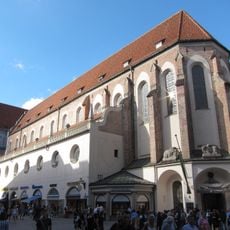
Frauenkirche, Catholic cathedral in central Munich, Germany
The Frauenkirche is a Catholic cathedral in central Munich, distinguished by twin towers topped with copper onion domes that rise 99 meters above street level. Built from red brick, the structure extends 109 meters in length and 40 meters in width, forming a Gothic landmark that dominates the city skyline.
Duke Sigismund and Bishop Tulbeck laid the foundation stone on 9 February 1468; the old church was demolished in 1472. Jörg von Halsbach chose brick because no quarry lay nearby, and the towers stood finished apart from their tops by 1488. The church was consecrated in 1494, and Halsbach, who died soon after, was buried inside it.
The name Frauenkirche means Church of Our Lady, from the dedication to the Virgin Mary; the full title is Dom zu Unserer Lieben Frau. Since 1821 it has been the cathedral church of the Archbishop of Munich and Freising. Inside, look for the tomb of Duke Ludwig the Bavarian by Hans Krumpper, and the Benno Arch that Hans Krumpper made between 1599 and 1604.
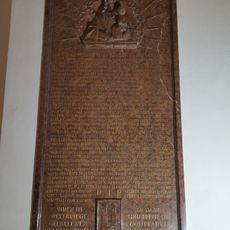
The south tower is reached by lift, but 86 steps on a spiral staircase come first; the north tower is closed to the public. Inside, the nave and choir cover 3,548 m², and the rows of pillars read as walls of light from the main portal. Look for the two commemorative plaques by the south-east portal marking the 1468 foundation stone.
A black footprint mark at the entrance bears the name Devil's Footstep and ties to a legend claiming the devil left his mark during construction. Visitors often pause at this spot to test the viewpoint from which the windows supposedly vanish from sight.
The community of curious travelers
AroundUs brings together thousands of curated places, local tips, and hidden gems, enriched daily by 92,710 contributors worldwide.