Zeitz Cathedral St. Peter and Paul, Gothic cathedral in Zeitz, Germany
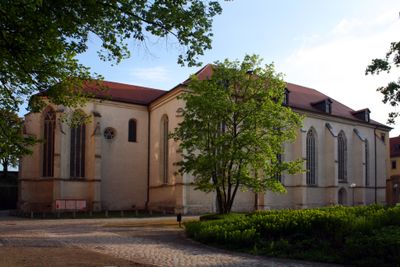
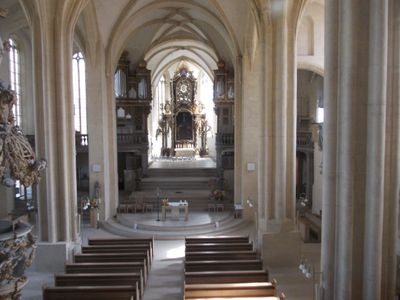
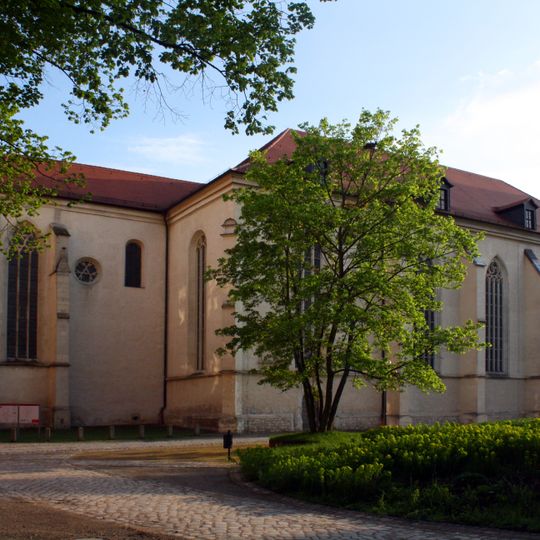
Zeitz Cathedral is a Gothic hall church of light beige stone, with a lower side aisle under a steep red tiled roof and a taller main body with a gabled end and tall pointed windows. Inside, clustered pillars carry pointed arches along the nave, and a stepped stone platform leads to a 1671 wooden altarpiece by Johann Caspar Sandmann.
Zeitz was made a bishopric in 968 by Emperor Otto I and his wife Adelheid, and the first cathedral was begun then; excavations found vague traces of it beneath the present building. After 1028 a new church was built, completed around 1100, and much of it survives. In 1656 Duke Moritz of Saxony-Zeitz had the cathedral rebuilt as the palace chapel of Moritzburg, removing the towers and adding a princely box.
The cathedral holds the grave of Georg Agricola, the 16th-century mineralogist who wrote De re metallica. His body was buried here, and the church is also a station on the Straße der Romanik, a route linking Romanesque monuments in Saxony-Anhalt.
The cathedral is a stop on the Straße der Romanik and serves as Zeitz's Catholic parish church. The three-nave hall crypt lies beneath the choir square, reached from the interior; its west wall extends into the crossing square. The south-west crossing pier collapsed in 1982 and was repaired in the restoration completed for the 2004 state garden show.
The cathedral's crypt dates to the 11th century and shows the earliest Romanesque building style in the city. This underground vault is one of the oldest surviving sections and reveals how the structure looked in its earliest days.
The community of curious travelers
AroundUs brings together thousands of curated places, local tips, and hidden gems, enriched daily by 94,321 contributors worldwide.