Schloss Jägerhof, Baroque castle in Düsseldorf, Germany
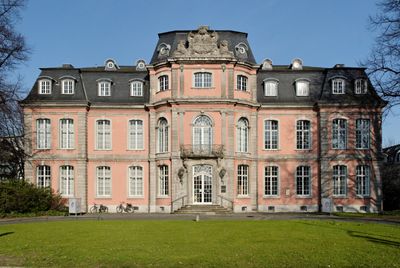
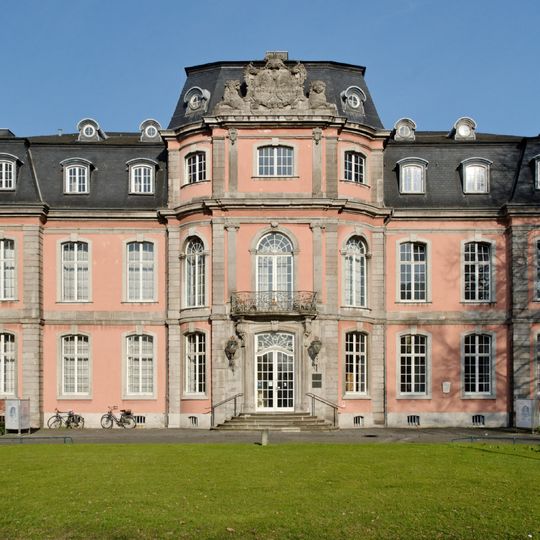
Schloss Jägerhof is a Baroque palace in Düsseldorf featuring late Baroque design with refined ornamentation and carefully chosen color schemes. The building sits near the Hofgarten gardens and functions as part of a larger cultural complex in the city's center.
Schloss Jägerhof was built from 1752 to 1763 on the orders of Elector Karl Theodor, following designs by Johann Joseph Couven and Nicolas de Pigage. It served as the seat of the supreme huntsmen until 1795, when French troops looted it and used it as a military hospital. In 1811 Napoleon and Marie Louise stayed here for four days. The side wings, added in the 1820s, were demolished in 1909 when the city acquired the building.
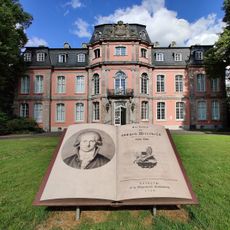
Since 1987 the palace has housed the Goethe-Museum alongside the Ernst Schneider Foundation, displaying the Anton and Katharina Kippenberg collection of Goethe's life and work. The museum also stages temporary exhibitions on literary and intellectual history.
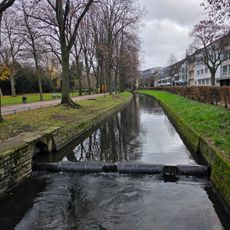
Schloss Jägerhof stands at Jacobistraße 2 in Pempelfort, just outside Düsseldorf's old centre. The palace forms the point de vue at the end of the Hofgarten's riding avenue, so it is reached on foot through the park. Visitors enter the central wing; the side wings were demolished in 1910, leaving a small fenced forecourt.
The palace is the point de vue closing the sightline of the Hofgarten riding avenue and Jägerhofstraße. Its side wings, added in the 19th century, were demolished around 1910 because they jutted 1.7 m past the new building line of the widened Jacobistraße, leaving only the central block seen today.
The community of curious travelers
AroundUs brings together thousands of curated places, local tips, and hidden gems, enriched daily by 93,837 contributors worldwide.