Schloss Fasanerie, Baroque palace in Eichenzell, Germany
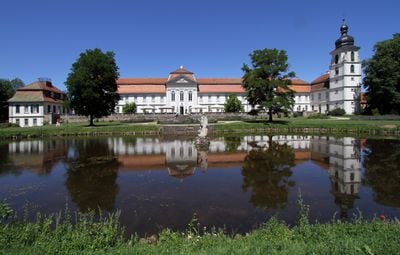
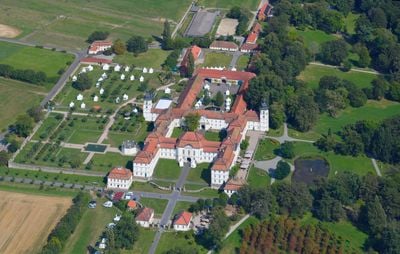
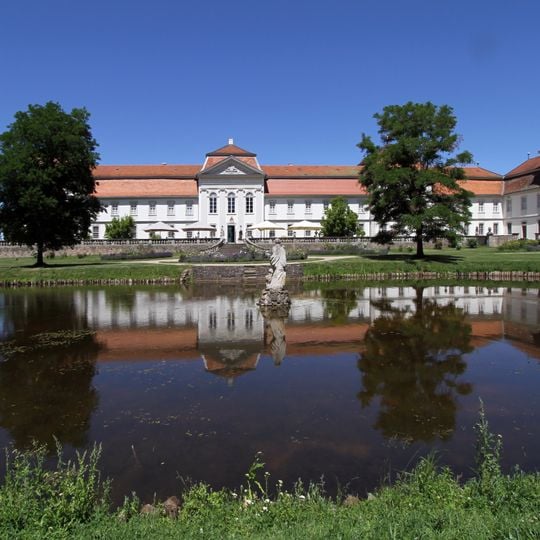
Schloss Fasanerie is a baroque palace in Eichenzell, near Fulda, built around a sequence of courtyards. Its white facade and red tiled roof enclose an inner courtyard, with symmetrical two-storey wings, domed towers with dark lanterns, and a central section with an arched entrance under a curved pediment. A stone balustrade and steps lead toward a wide pond.
Around 1710 Abbot Adalbert von Schleifras had a modest country house built, probably to plans by Johann Dientzenhofer; it still forms the core between two towers. From 1730 Abbot Adolph von Dalberg extended it, and by 1757 Prince-Bishop Amand von Buseck had it enlarged by court architect Andrea Gallasini. Confiscated after Prussia annexed Kurhessen in 1866, it returned to Landgrave Friedrich Wilhelm von Hessen-Kassel in 1878.
The porcelain collection inside displays pieces from different European manufacturers and time periods that visitors encounter while walking through the rooms. This reflects the former residents' appreciation for fine craftsmanship and valuable objects.
Visitors can join guided tours from April through November with hourly departures that allow exploration of the rooms and exhibitions. The grounds also have paths to walk and time to look around the gardens.
The name Fasanerie means pheasantry, yet the sources record no pheasant-breeding origin: the estate was bought in the early 18th century by Prince-Abbot Adolph von Dalberg as a hunting pavilion called Adolphseck. The old core, the Schlösschen, sits between two towers, and the eastern gate passage of 1730 still closes the second courtyard.
The community of curious travelers
AroundUs brings together thousands of curated places, local tips, and hidden gems, enriched daily by 93,176 contributors worldwide.