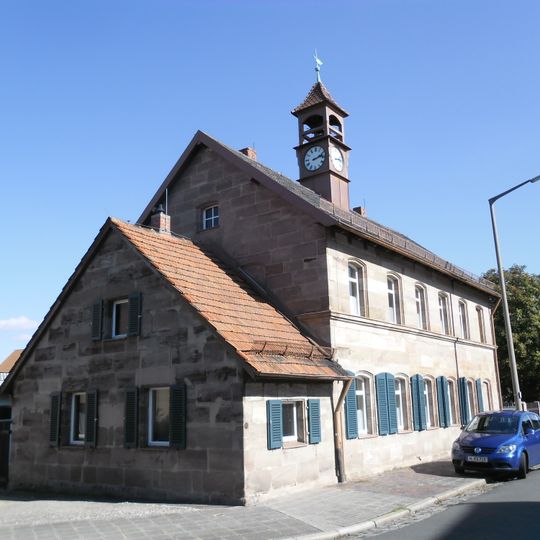
Höfen, Statistical district in Nuremberg, Germany.
Höfen is a statistical district in northwest Nuremberg, combining residential neighborhoods with schools, parks, and everyday community facilities. The area covers several blocks with varied street patterns and green spaces woven throughout.
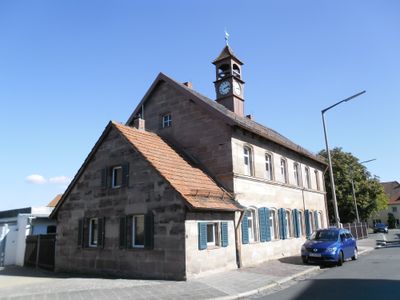
Höfen was first documented in 1343 as "Hoͤfen", then a row of seven farmsteads along today's Weikershofer Straße. On 10 July 1449 Margrave Albrecht Achilles burned the village during his feud with Nuremberg over Gostenhof. In 1721 the community hired a schoolmaster but was too poor to build a school, so lessons moved between buildings; the village was absorbed into Nuremberg on 31 December 1898.
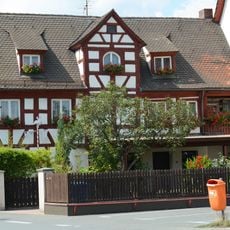
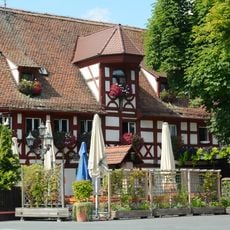
Höfen was long shaped by the Lutheran parish of St. Michael in neighbouring Fürth; today the Erlöserkirche in Leyh serves the Protestant residents, while Catholics belong to Zu den Heiligen Schutzengeln in Nuremberg. The street village's old farmsteads along Weikershofer Straße, several now listed buildings, still mark the settlement's rural layout.
Höfen lies in western Nuremberg, bounded by the Fürth city limit to the west and the Ringbahn to the east. It is linked to the Südwesttangente via the Nürnberg-Leyh/Höfen and Nürnberg-Kleinreuth junctions. Nuremberg city bus lines 38 and 39 and Fürth line 179 pass through, connecting to the Fürth Hauptbahnhof, Maximilianstraße, Gustav-Adolf-Straße and Stadtgrenze U-Bahn stations.
Höfen was first recorded in 1343 as "Hoͤfen", when it consisted of seven farmsteads along today's Weikershofer Straße. On 10 July 1449 Margrave Albrecht Achilles burned the village during his dispute with Nuremberg over Gostenhof. The community had its own mayors only from 1810 to 1898, and its own cemetery was laid out in 1884 on the highest point of the district.
The community of curious travelers
AroundUs brings together thousands of curated places, local tips, and hidden gems, enriched daily by 94,562 contributors worldwide.