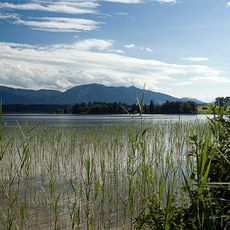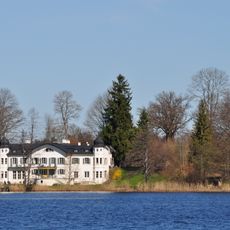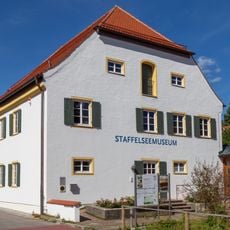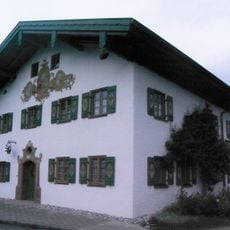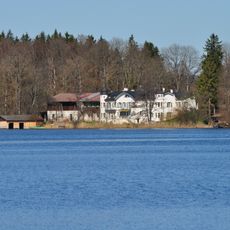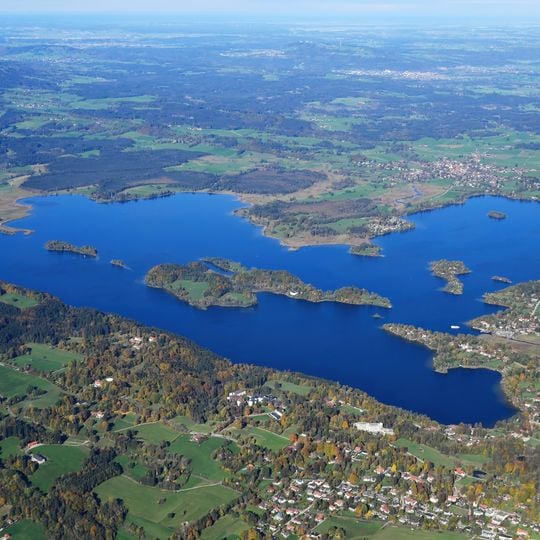
Staffelsee, Lake in the Ammer-Loisach hills, Garmisch-Partenkirchen district, Germany
Staffelsee is a lake in the Ammer-Loisach hill country of the Garmisch-Partenkirchen district, about 4.6 km long and 3.7 km wide, with a surface of just under 8 km² and a depth of nearly 40 m. Its shoreline is indented with wooded promontories and inlets, and seven tree-covered islands lie in the water, including the long Wörth and the small Jakobsinsel. The lake is divided into three parts: Untersee in the north, Obersee in the southwest and Stegsee in the southeast.
Wörth, the largest and only permanently inhabited island, was the site of Staffelsee Abbey, a Carolingian monastery founded in the 8th century and dissolved in the 11th century. When the former monastery church became a parish church, a wooden footbridge was probably first built over the Jakobsinsel in the 11th century to reach it from the shore. Its posts remain visible under water, and a 1770 picture shows the bridge; according to a booklet of 1853 it still existed then.
The lake attracted painters like Wassily Kandinsky and Gabriele Münter in the early 1900s, who worked here and helped establish the area as an art hub. This artistic legacy still shapes how locals and visitors experience the shores today.
The lake is accessible by regional train service from Munich, making it straightforward to plan a visit. Nearby towns offer accommodation options and facilities for various activities along the shoreline.
The lake holds seven wooded islands, more than any other lake in the Alpine foothills. The smallest, Jakobsinsel, once carried a wooden footbridge from the Burg peninsula to Wörth, probably first built in the 11th century; its posts remain under water, colonised by freshwater sponges (Spongilla lacustris) that grow larger than a man, though books give the species a maximum of 30 cm.
The community of curious travelers
AroundUs brings together thousands of curated places, local tips, and hidden gems, enriched daily by 92,781 contributors worldwide.