New Town Hall, Renaissance Revival town hall on Schlossplatz, Wiesbaden, Germany.
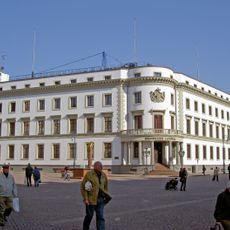
The New Town Hall is the seat of the mayor and city council of Wiesbaden, on the Schlossplatz opposite the Stadtschloss. Georg von Hauberrisser built it in Renaissance Revival style between 1883 and 1887; the market facade runs about 100 metres, with an angled corner, two octagonal turrets, a stepped central gable and partial cladding of red Main sandstone. The Schlossplatz front was rebuilt in simplified form in the early 1950s after wartime destruction.
In 1882 the growing city held an architects' competition for a new town hall, as the 17th-century Old Town Hall no longer offered enough space or prestige. Georg von Hauberrisser's winning design was built under his direction and inaugurated in 1887. In February 1945 the building was partly destroyed; in 1949 the main gable was demolished for fear of collapse and the Schlossplatz front was rebuilt in simplified form with an added storey.
The Ratskeller in the basement was painted in 1890 by Kaspar Kögler, with his student Wilhelm Weimar and the Munich painter Heinrich Schlitt, who decorated the beer cellar with humorous scenes and sayings. A mocking rhyme at the entrance was painted over during the Nazi period; when the building was restored in 1987 the council decided against uncovering the frescoes for cost reasons, and they were removed for good.
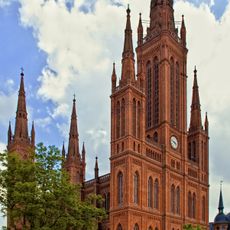
The building faces the Schlossplatz, opposite the Stadtschloss and beside the Marktkirche; the rear side opens onto the Marktplatz with the Marktsäule. The Ratskeller restaurant occupies almost the entire basement, and the preserved vaulted entrance hall and staircase can be seen inside. The large meeting hall is the representative room of the house.
The Ratskeller in the basement was painted in 1890 by Kaspar Kögler and his pupil Wilhelm Weimar, with Heinrich Schlitt decorating the beer cellar. A mocking rhyme at the entrance was later painted over under National Socialism; when the frescoes were uncovered during the 1987 restoration, the council had them erased rather than restored, so they were lost for good.
The community of curious travelers
AroundUs brings together thousands of curated places, local tips, and hidden gems, enriched daily by 92,894 contributors worldwide.