Paula Modersohn-Becker Museum, Art museum in Mitte, Bremen, Germany
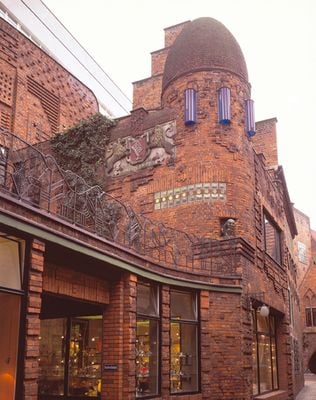
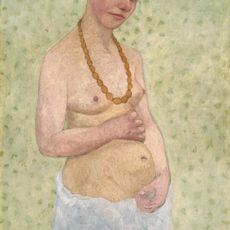
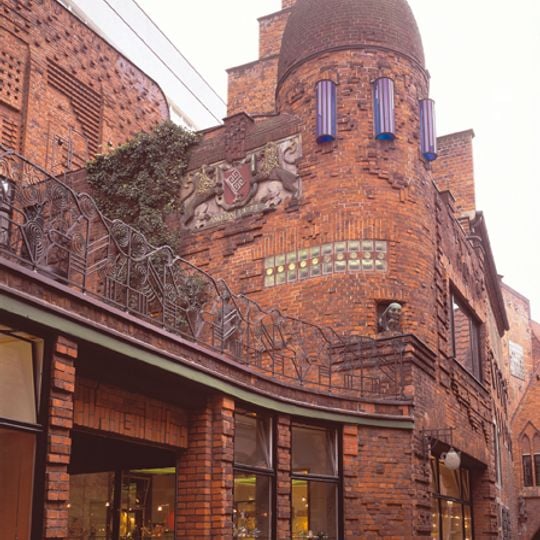
The Paula Modersohn-Becker Museum occupies a brick Expressionist building on Böttcherstraße, designed by Bernhard Hoetger and opened in 1927. Its red-brown facade combines straight walls with a rounded corner turret capped by a dark dome; three vertical blue glass panes sit above a small sculpted head, and a shield relief flanked by two animals is set into the upper brickwork. Inside, the collection shows key works from every phase of Paula Modersohn-Becker's career, from her Berlin training years to the Paris paintings of 1906–07.
Ludwig Roselius, inventor of decaffeinated coffee, commissioned Bernhard Hoetger in 1924 to remodel Böttcherstraße; the museum opened on 2 June 1927, Roselius's 53rd birthday, as the Paula-Becker-Modersohn-Haus. In 1936 Hitler denounced the street's Expressionist style at the Nuremberg rally, and the collection was reduced to a private one visitable only on request. The building has been a protected monument since 1973 and was restored and extended by 1994.
The building opened in 1927 as the Paula-Becker-Modersohn-Haus, placing the artist's birth name first. A plaque at the Böttcherstraße entrance carried a verse praising her work; under the Nazis the word "wenn" was changed to "bis" so her art would not be said to outlast men's heroic deeds. The original wording has since been restored.
The museum occupies the Paula-Becker-Modersohn-Haus on Böttcherstraße, a narrow lane in Bremen's Mitte district that runs from the Marktplatz to the Weser. The building was extended and renovated up to 1994, and the rooms Hoetger designed now host temporary exhibitions of classic modern art alongside the permanent collection. The stairwell holds Jenny Holzer's electronic homage to the painter, installed in 2005.
The museum opened on 2 June 1927, Roselius's 53rd birthday, together with the rebuilt Böttcherstraße. Roselius named it the Paula-Becker-Modersohn-Haus, putting the artist's birth name first. In 1936 the Nazis branded the street 'degenerate art'; it survived as a warning example, and Roselius put money into the Focke-Wulf aircraft company instead.
The community of curious travelers
AroundUs brings together thousands of curated places, local tips, and hidden gems, enriched daily by 93,082 contributors worldwide.