Plankstetten Abbey, Benedictine monastery in Berching, Germany.
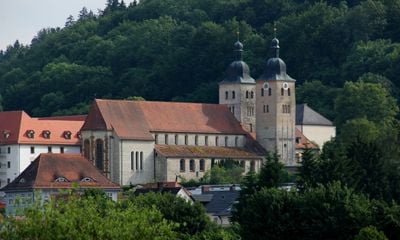
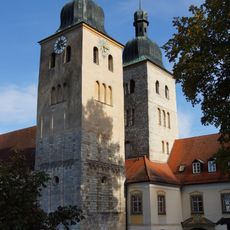
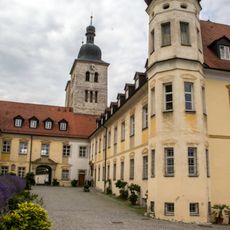
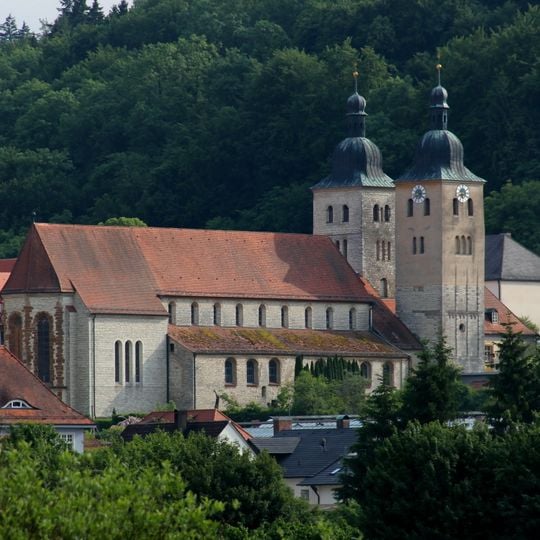
Plankstetten Abbey is a Benedictine monastery in Berching built of pale grey stone, its main body covered by a long, steeply pitched roof of reddish-brown tiles. To the right stand two tall square towers, each with arched openings, a round clock face and a dark bulbous dome topped by a small lantern and cross. A row of small arched windows runs along the main facade, with larger arched windows below the roof.
Plankstetten Abbey was founded in 1129 by Count Ernst II of Grögling and his brothers, with Bishop Gebhard II of Eichstätt, and consecrated on 1 November 1138; the Romanesque crypt survives from that time. Abbot Ulrich IV Dürner (1461–1494) reformed the community and founded the brewery. The abbey was damaged in the Peasants' War of 1525 and the Thirty Years' War, dissolved in 1806 during secularisation, and re-established in 1904 as a priory of Scheyern, becoming an abbey again in 1917.
Since 17 October 1980 the abbey has held a Young People's Vespers on the third Friday of each month, modelled on the youth vespers of Kremsmünster Abbey in Austria and on the prayers of Taizé. The monks also serve as parish priests for Plankstetten and a neighbouring village.
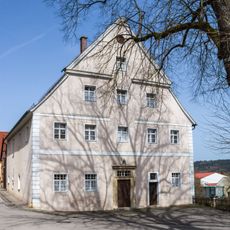
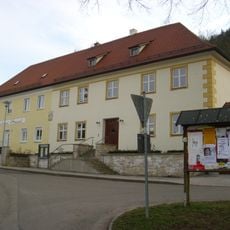
The abbey lies between Berching and Beilngries, south of Neumarkt in der Oberpfalz. The guesthouse opposite the main gateway occupies the former boarding facilities, and the monastery shop sells products from the organic farm, butchery, bakery and plant nursery. The church and grounds can be visited on foot.
The monastery operates a certified organic farm surrounding its buildings, where monks grow crops and raise livestock to sustain the community. This working agricultural landscape integrates traditional farming methods with contemporary ecological practices that visitors can observe directly.
The community of curious travelers
AroundUs brings together thousands of curated places, local tips, and hidden gems, enriched daily by 94,080 contributors worldwide.