Büraburg, Castle ruin and archaeological site in Fritzlar, Germany.
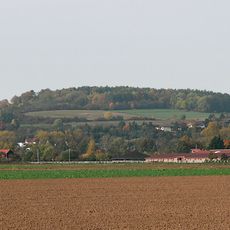
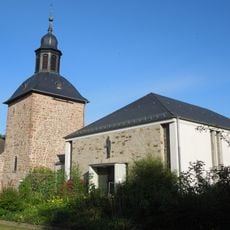
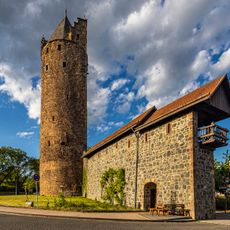
The Büraburg is a ruined Frankish hill castle on the 275 m Büraberg spur above Ungedanken, a district of Fritzlar. Excavations found mortar walls up to 2.70 m thick, three gates and at least sixty building traces across the 8-hectare interior. On the summit plateau stands the St. Brigida chapel, whose chancel arch wall was radiocarbon-dated to 543–668.
Around 690 the Franks built a hillfort with walls and ditches enclosing 8 hectares; finds of spurs and harness fittings indicate a mounted garrison. In 742 Boniface made Büraburg a bishopric, the first north of the Roman Limes, with Witta as bishop. In 774 the people of Fritzlar withstood a Saxon siege there. After 804 the site lost its military role.
The church on the summit is dedicated to St. Brigida, an Irish national saint, and is still the goal of annual processions and pilgrimages. Its chancel arch wall was dated by C-14 analysis of charcoal in the mortar to between 543 and 668, which would make it the oldest church building north of the Limes. Excavations from 1969 to 1996 uncovered a monastic complex with a stone-lined cistern bearing a Benedictine cross, possibly housing an abbot and up to six monks.
The site is accessible year-round and can be visited during walks, with the hill offering good views of the surrounding area. The best time to visit is during dry weather, as paths on the slope can become slippery.
Excavations have uncovered a large network of fortifications from the 7th and 8th centuries that was remarkably large for its time. These discoveries show that the site was one of the most important military installations in the region for centuries.
The community of curious travelers
AroundUs brings together thousands of curated places, local tips, and hidden gems, enriched daily by 94,229 contributors worldwide.