Osthaus-Museum Hagen, Art museum in Hagen, Germany
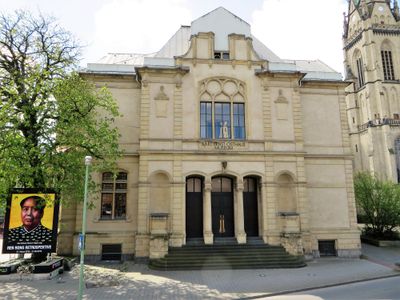
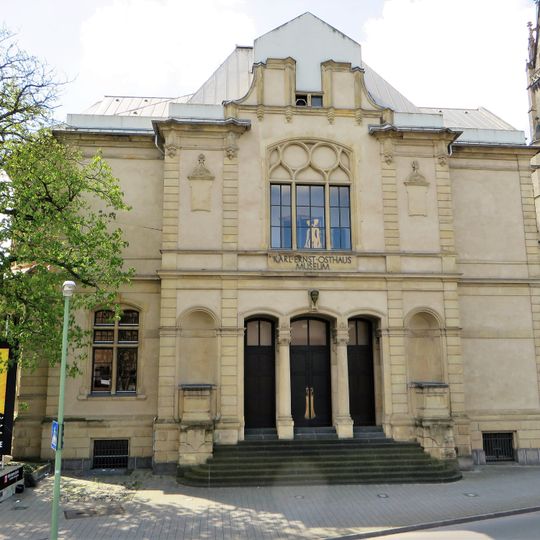
The Osthaus Museum Hagen houses modern artworks within a building showcasing distinct Art Nouveau elements designed by Belgian architect Henry van de Velde. The rooms combine artistic design with displays of works from the early 20th century.
Karl Ernst Osthaus commissioned the Berlin architect Carl Gérard to build the museum in 1898, then had Henry van de Velde design the interior from 1900. It opened in 1902 as the Museum Folkwang, the world's first museum of contemporary art. After Osthaus died in 1921, his heirs sold the collection and name rights to Essen in 1922; the empty Hagen building became offices for the Kommunales Elektrizitätswerk Mark. Reopened as a city art museum in 1930, it was renamed Karl-Ernst-Osthaus-Museum in 1939 and took its present name in 2009.
The museum's name honours Karl Ernst Osthaus, who opened the Folkwang collection here in 1902 as the world's first museum of contemporary art. In summer 1907 he showed works by the Brücke artists, and he kept close contact with Ernst Ludwig Kirchner, Emil Nolde and Alexander Archipenko. Since 2009 the shorter name Osthaus Museum Hagen has been used, dropping the form introduced under National Socialism.
The entrance is reached by a short flight of grey stone steps, and the three double doors sit above small barred basement windows. Inside, the historic entrance hall displays art around 1900, while the Rohlfs room is on the upper floor and the Junge Museum occupies the souterrain. The building is shared with the Emil Schumacher Museum as the Kunstquartier Hagen.
The building once served as office space for an electric utility company before being transformed into a museum after World War II under the direction of Herta Hesse. This second life demonstrates how historic structures can be revived for new purposes.
The community of curious travelers
AroundUs brings together thousands of curated places, local tips, and hidden gems, enriched daily by 92,837 contributors worldwide.