Villa Post, architectural heritage monument in Hagen, Germany
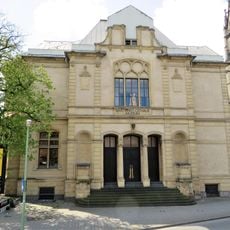
Villa Post is a cubic, two-story brick building with stone detailing and a shallow, tile-covered hip roof, built in 1892 in the late-classicist style with Renaissance references. Columns frame the entrance portal, and shell rosettes and applied pilasters decorate the facade. Inside, a marble entrance area and extensive wooden fittings remain. It stands in a small park with old beeches near the railway station in Hagen.
The Wehringhausen merchant Wilhelm Post had the villa built in 1892 next to his hammer works. The city of Hagen bought it in 1927 and opened a museum there in 1932, showing works by Christian Rohlfs. In 1937 the Nazi campaign against "degenerate art" removed almost all Rohlfs works, many of which were destroyed. After other uses, it was listed as a monument in 1987 and restored with EU, state and city funding before reopening in 1998 as the Volkshochschule.
The name comes from Wilhelm Post, the Wehringhausen merchant who had the villa built in 1892 beside his hammer works. Since 1998 it has housed the Volkshochschule Hagen, the municipal adult education centre, whose courses and seminars fill the former living rooms and marble entrance hall.
The villa stands in a small park with old beeches near Hagen's main railway station, so it is easily reached on foot from the station. Since 1998 it has served as the Volkshochschule Hagen's main building and seminar venue; course participants register in advance through the adult education centre.
The villa stands in a small park with old beech trees near Hagen's railway station, not by the Ennepe. Wilhelm Post, a merchant from Wehringhausen, built it in 1892 close to his hammer works, so the family home and the business sat side by side.
The community of curious travelers
AroundUs brings together thousands of curated places, local tips, and hidden gems, enriched daily by 94,137 contributors worldwide.