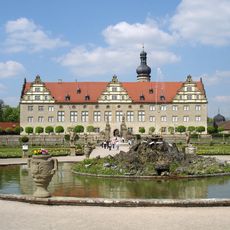
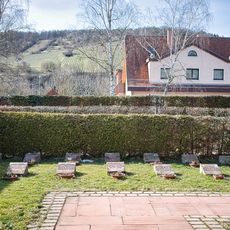
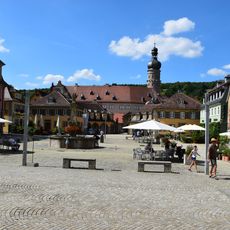
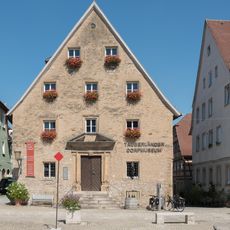
Schloss Weikersheim Gallery, Sculpture collection at Weikersheim Palace Gardens, Germany.
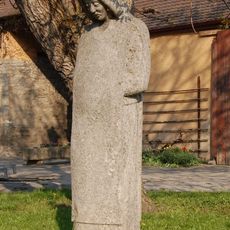
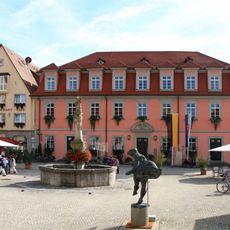
The Zwergengalerie Schloss Weikersheim is a row of sixteen caricatured stone figures in the palace park, depicting the court of a small Baroque residence. Carved from yellowish-green sandstone, they stand from the Gewehrhaus to the Gärtnerhaus and include a court huntsman, a fool, a cellarer with a ham, and a cook. They are considered the only fully preserved ensemble of a Baroque dwarf garden.
Johann Jacob Sommer of Künzelsau carved fourteen of the sixteen figures in 1711 and 1712, paid 8 Rhenish guilders each, with his sons supplying the rest at an unknown date. The court accounts record the commission; the figures were carved from yellowish-green Keuper sandstone from quarries at Freudenbach and Mangoldsall. Their names, such as the court Jew Lämle Seeligmann, probably date from the 19th century.
The sixteen figures portray the court of a small baroque residence: the master of the hunt, the court jester, the cellarer swinging a goblet and a ham, the lovesick gardener with a rose bouquet, the chambermaid plagued by a pug, and the bearded court Jew and banker Lämle Seeligmann. Their names probably date from the 19th century. The Weikersheim dialect poet Heinz Sausele dedicated a cycle of poems to the ensemble.
The figures are located along paths that wind through the gardens so visitors can view each one while strolling. Walking the grounds requires only normal physical fitness since the paths are straightforward to follow.
Many of the stone figures still come from the Baroque period and stand in their original positions throughout the garden. This makes the collection an authentic example of how such gardens were originally designed.
The community of curious travelers
AroundUs brings together thousands of curated places, local tips, and hidden gems, enriched daily by 94,035 contributors worldwide.